Archives: Blogs

  • NEGOTIABLE INSTRUMENTS ACT (NI ACT) 1881

    NEGOTIABLE INSTRUMENTS ACT (NI ACT) 1881

    INTRODUCTION

    In India, the Negotiable Instruments Act was passed during 1881 which came into force from March 01, 1882. Originally, it had 137 Sections. Sections 138 to 142 were added in 1988, and Sections 143 to 147 were added during December 2002. At present it has 147 sections and 17 Chapters. It extends to the whole of India. According to Section 13 (a) of the Act, Negotiable Instruments means Promissory Note (PN), Bill of Exchange (BOE) and Cheque.

    Features of Negotiable Instruments are as under:

    • A negotiable instrument is freely used by the parties in their business deal as a medium of payment.
    • The word ‘negotiable’ means the transfer of ownership of the instrument from one person to another person for consideration.
    • Transferred Negotiable Instruments will further transfer without any restriction;
    • The transferee taking the instrument for value and in good faith, gets better and absolute title despite any defect in the title of the transferor.
    • The property in a negotiable instrument, i.e. the complete right of ownership, and not merely the possession passes, in the case of bearer instruments, by mere delivery, and in case of order instruments, by endorsement and delivery.
    • The holder in due course is not, in any way, affected by the defect of the title of his transferor or any prior party.
    • The holder in due course can sue upon a negotiable instrument in his name.
    • The transferee of a negotiable instrument is known as ‘holder in due course.’ A bona fide transferee for value is not affected by any defect of title on the part of the transferor or of any of the previous holders of the instrument.
    • The instrument may be defined as a written document that creates a right in favour of some person.
    • Negotiable instrument means Promissory Note (PN), Bill of Exchange (BE), and Cheque payable to order or bearer.

     DIFFERENT TYPES OF NEGOTIABLE INSTRUMENTS

     PROMISSORY NOTES

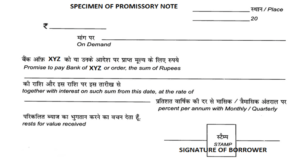
    Section 4 of the Act defines, “A promissory note is an instrument in writing (note being a bank-note or a currency note) containing an unconditional undertaking, signed by the maker, to pay a certain sum of money to or to the order of a certain person, or to the bearer of the instruments.”  Example- If A writes “I promise to pay B or order Rs. 5000”.

    SPECIMEN OF A PROMISSORY NOTES
    An instrument to be a promissory note must possess the following elements:

    1. It must be in writing,
    2. It must certainly be an express promise or clear understanding to pay a certain sum of money,
    3. The promise should be to pay money and money only,
    4. Promise to pay must be unconditional,
    5. It should be signed by the maker,
    6. The maker & payee must be certain.


    BILL OF EXCHANGE

    Section 5 of the Act defines, “A bill of exchange is an instrument in writing containing an unconditional order, signed by the maker, directing a certain person to pay a certain sum of money only to, or to the order of a certain person or to the bearer of the instrument”.

    A bill of exchange, therefore, is a written acknowledgment of the debt, written by the creditor and accepted by the debtor. There are usually three parties to a bill of exchange drawer, the acceptor or drawee and the payee. Drawer himself may be the payee.

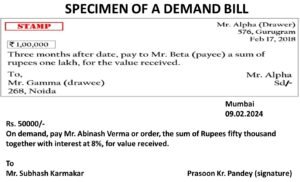
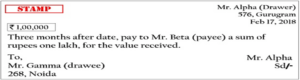
    For example, Mr. Alpha directed Mr. Gama for payment of Rs. 100,000 to Mr. Beta.

    SPECIMEN OF A DEMAND BILL
    Essential conditions of a bill of exchange

    (1) It must be in writing.

    (2) It must be signed by the drawer.

    (3) The drawer, drawee, and payee must be certain.

    (4) The sum payable must also be certain.

    (5) It should be properly stamped.

    (6) It must contain an express order to pay money and money alone.

    CHEQUES

    Section 6 of the Act defines “A cheque is a bill of exchange drawn on a specified banker, and not expressed to be payable otherwise than on demand”.

    SPECIMEN OF A CHEQUE
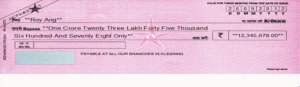
    A cheque is a bill of exchange with two more qualifications, namely,

    (i) it is always drawn on a specified banker, and

    (ii) it is always payableon demand. Consequently, all cheque are bill of exchange, but all bills are not cheque.

    A cheque must satisfy all the requirements of a bill of exchange; that is, it must be signed by the drawer and must contain an unconditional order on a specified banker to pay a certain sum of money to or to the order of a certain person or to the bearer of the cheque. It does not require acceptance.

    OTHER NEGOTIABLE INSTRUMENTS

    The following are also considered as negotiable instruments:

    • Demand Draft,
    • Hundi,
    • Traveller Cheque,
    • Gift Cheque,
    • Dividend Warrant,
    • Interest Warrant,
    • Bankers’ Cheque,
    • Pay Order,
    • Commercial Paper.

    NOT A NEGOTIABLE INSTRUMENTS

    The following are not Negotiable Instruments:

    • Deposit Receipt,
    • NSC,
    • Postal Order,
    • Share Certificate,
    • Bill of Lading,
    • Lorry Receipt,
    • Airway Bill,
    • Railway Receipt,
    • Stock Invest,
    • Dock Warrant

    PARTIES TO NEGOTIABLE INSTRUMENTS

    • Drawer: The maker of a bill of exchange is called the ‘drawer’.
    • Drawee: The person directed to pay the money by the drawer is called the ‘drawee’.
    • Payee: The person named in the instrument, to whom or to whose order the money is directed to be paid by the instrument is called the ‘payee’. He is the real beneficiary under the instrument.
    • Endorser: When the holder transfers or endorses the instrument to anyone else, the holder becomes the ‘endorser’.
    • Endorsee: The person to whom the bill is endorsed is called an ‘endorsee’.
    • Holder: A person who is legally entitled to the possession of the negotiable instrument in his own name and to receive the amount thereof, is called a ‘holder’. He is either the original payee or the endorsee. In case the bill is payable to the bearer, the person in possession of the negotiable instrument is called the ‘holder’.
    • Holder in Due Course: defined in Section 9 of the NI Act. Holder in due course is a person who became possessor of a NI for valuable consideration, in good faith, before becoming due, and without having any reason to believe that the person transferring the instrument was not entitled thereto. if before the amount mentioned in it became payable, and without having sufficient cause to believe that any defect existed in the title of the person from whom he derived his title.

     CLASSIFICATION OF BILLS

    Bills can be classified as:

    (1) Inland and foreign bills. (Place wise)

    (2) Time and demand bills. (Period wise)

    (3) Trade and accommodation bills. (Nature wise)


     (1) Inland and Foreign Bills

    Inland bill

    A bill is, named an inland bill if drawn and made payable in India. A bill drawn or made in India & payable in or drawn upon any persons in India. The requirements for inland bills are:

    (a) It must be drawn in India on a person residing in India, whether payable in or outside India, or

    (b) It must be drawn in India on a person residing outside India but payable in India.

    Foreign Bill

    A bill which is not an inland bill is a foreign bill. The following are the foreign bills:

    1. A bill is drawn outside India and made payable in India.
    2. A bill is drawn outside India on any person residing outside India.
    3. A bill is drawn in India on a person residing outside India and made payable outside India.
    4. A bill is drawn outside India on a person residing in India.
    5. A bill is drawn outside India and made payable outside India.

     (2) Time and Demand Bill

    Time or Usance bills

    A bill payable after a fixed time is termed as a time bill. In other words, bill payable “after date” is a time or usance bill.

     Demand bill

    A bill payable at sight or on demand is termed a demand bill.

     (3) Trade and Accommodation Bill

    Trade bill

    A bill drawn and accepted for a genuine trade transaction is termed a “trade bill”.

     Accommodation bill

    A bill drawn and accepted not for a genuine trade transaction but only to provide financial help to some party is termed an “accommodation bill”.

    Example: A, needs money for three months. He induces his friend B to accept a bill of exchange drawn on him for Rs. 1,000 for three months. The bill is drawn and accepted. The bill is an “accommodation bill”. A may get the bill discounted from his bankers immediately, paying a small sum as a discount. Thus, he can use the funds for three months and then just before maturity, he may remit the money to B, who will meet the bill on maturity. In the above example, A is the “accommodated party” while B is the “accommodating party”.

     ACCEPTANCE OF BILL OF EXCHANGE

    The acceptance of a bill means signing by the drawer of a bill, on face with or without the words accepted and delivery thereof or giving notice of signing, to the holder of the bill. There are 2 types of acceptances i.e. general acceptance and qualified acceptance. In cases of several drawees not being partners, each of them can accept it for himself but not others without their authority (Sec 34).

     Dishonour of bill of exchange

    A bill of exchange is said to be dishonoured either by non-acceptance (when the drawee defaults in acceptance) or by non-payment (when the acceptor/drawee makes defaults in payment). Similarly, where the drawee is incompetent to contract or acceptance is qualified, the bill is said to be dishonoured (Sections 91 & 92).

     Presentation for acceptance

    As per Section 61, a usance bill payable after sight and bills payable on a fixed date (and not demand bills) require to be presented to drawee for acceptance to make him liable and also for calculation of due date.

     Negotiation

    when a promissory note, bill of exchange, or cheque is transferred to any person to constitute that person the holder thereof, the instrument is said to be negotiated.

     Negotiation of bearer instruments

    A bearer instrument is negotiated by mere delivery and no endorsement is required.

     Negotiation of an order instrument

    An order instrument can be negotiated by endorsement followed by delivery. It may be noted that legal heirs cannot complete the negotiation of a negotiable instrument with endorsement by the deceased merely by delivery.

     ENDORSEMENT

    The signing of an instrument on the back of a slip of paper annexed thereto for negotiation is called endorsement (Section 15). The person who transfers the instrument is called the endorser and the person to whom it is transferred is called the endorsee. Various types of endorsements are as under:

     1) Blank Endorsement

    In a blank endorsement the endorser just signs his name without indicatingendorsee. It can be converted into full by writing name of a person above signatures. The effect of anendorsement in blank is that it makes an instrument drawn originally payable to order to bearer instrument for the purpose of negotiation which can be further negotiated by mere delivery.

     2) Endorsement in Full

    When the endorser indicates the name of the endorsee it is called a full endorsement.

    3) Sans Recourse Endorsement

    An endorsement in which the endorser excludes his liability is termed ‘sans recourse’ or ‘without recourse’ endorsement. In case of dishonour of the instrument, the amount cannot be recovered from such endorser.

     4) Facultative

    An endorsement in which endorser waives the notice of dishonour is called Facultative endorsement But this is not applicable to other parties to the instrument.

     5) Restrictive endorsement

    An endorsement which restricts further right of negotiation is called as restrictive endorsement. For example if it is written in the endorsement as “Pay to Hari for my use” itis restrictive endorsement.

     6) Conditional Endorsement

    When along with endorsement, a condition is imposed by endorser. For example, pay to C on completion of studies. Paying bank not to ensure compliance of condition. Condition binds endorser and endorsee only.

     7) Back-to-Back Endorsement

    An endorsement in which the endorser himself becomes endorsee iscalled as back to back endorsement and in such a case, the endorsee can recover the amount only from parties prior to his own endorsement.

     8) Negotiation Back

    When the drawer of a cheque himself becomes endorsee, it is called “Negotiation Back” and this cheque is treated as satisfied.

     9) Partial Endorsement

    The endorsement can be made only for full amount but in case part payment has been received and a note to that effect is made on the instrument, then the same can be endorsed for the balance amount.

     10) Forged Endorsement

    When an endorsement is made by a person other than the Holder by forging signatures of the Holder Title does not pass to any person based on such endorsement. A person getting an instrument after such endorsement does not become a holder.

     Regularity of endorsement

    The paying bank gets protection u/s 85(1) only when endorsement is regular (may not be genuine).

     PAYMENT IN DUE COURSE

    As per Section 10 of N.I. Act. ‘payment in due course means payment according to the apparent tenor of the instrument in good faith and without negligence to any person in possession thereof under circumstances which do not afford a reasonable ground for believing that he is not entitled to receive payment of the amount therein mentioned’.

    Section 85 of the NI Act conditions to be satisfied for being a payment in due course.

    • Payment is under the apparent tenor of the instrument,
    • Payment must be in good faith and without negligence,
    • Payment must be made to the person in possession of the instrument,
    • The banker should not have any reasons to “disbelieve” the integrity/honesty of the possessor, i.e. no reasons to think that he is not entitled to receive the payment.
    • Payment must be made in money only.

     INCHOATE INSTRUMENTS

    As per section 20 of the NI Act, an instrument on which the date, payee, or amount is not mentioned is called an inchoate or incomplete instrument. Incomplete cheque can be completed by the Holder and the completion so made will not be treated as material alteration.

    An instrument without signatures is not treated as an instrument at all.

     AMBIGUOUS INSTRUMENTS

    Where the instrument is drawn in such a manner that it can be construed both as PN or BE.

    In the following cases, the instrument is taken as ambiguous:

    (a) Where drawer and drawee are the same person.

    (b) Where drawee is a fictitious person. E.g. Lord Krishna etc.

    (c) Where a drawee is a person incapable of entering into a contract.

    SOME IMPORTANT SECTIONS OF THE NEGOTIABLE INSTRUMENTS ACT:

    01 Indian Paper Currency Act 1871 not to be affected by the provisions of this Act.

    04 Promissory note defined

    05 Bill of exchange defined

    06 Cheque defined (also include electronic cheque and truncated cheque)

    07 Drawer, drawee in case of need, acceptor, acceptor for honour, payee defined

    08 Holder defined

    09 Holder in due course defined

    10 Payment in due course: Paying banker’s protection if payment is made in due course

    11 Inland instruments defined — drawn and made payable in India

    12 Foreign instruments defined.

    13 Negotiable instruments defined indirectly

    14 Negotiation defined.

    15 Endorsement and endorser defined

    16 Endorsement in blank and in full and endorsee defined.

    17 Ambiguous instruments

    18 Difference in amount in words and figures. Amount in words to be paid

    20 Inchoate stamped instruments – Holder has implied authority to complete the instrument..

    22 3 days of grace are allowed on a usance Bill of Exchange/Promissory note.

    25 When a BOE/PN matures on a holiday — due date on the next preceding working day.

    26 A minor can draw, endorse deliver and negotiate a negotiable instrument to bind all parties except himself.

    31 Banker’s obligation to pay cheque & compensate drawer for wrongful dishonour.

    65 Presentment for acceptance to be made during the usual business hours.

    80 If no interest rate is mentioned in the Promissory Note interest @ 18% p.a. is to be paid.

    85-1 Paying banker protected by payment in due course of an order cheque which is properly endorsed by the payee or his agent.

    85-2 Protection to paying banker in case of a bearer cheque.

    85-A Protection to paying bankers in case of Bank drafts.

    87 Material alteration renders NI renders void,

    89 Protection to paying banker for the materially altered instrument.

    99 Noting — must for foreign instruments

    100 Protest — must for foreign instruments

    105-107 Reasonable time — for presentment, dishonour, and transmission of notice

    123 General crossing

    124 Special crossing

    125 Who can crass – holder, banker

    126-127 Payment of cheque crossed generally or specially

    128 Payment in due course of crossed cheques

    129 Paying banker liable to the true owner for loss when payment is not made in due course.

    130 ‘Not Negotiable’ crossing — the transferee does not get a better title than that of the transferor.

    131 Protection to collecting bank for crossed cheques subject to compliance of conditions

    131-A Protection to collecting bank for crossed bank drafts.

    138 Drawer’s liability for cheque returned unpaid for insufficient funds

    139 Unless proved otherwise, it will be presumed that the cheque has been issued for the discharge of a debt/liability.

    140 The drawer cannot plead that he did not expect the cheque to be dishonoured.

    141 Offences by companies

    147 Offences to be compoundable
     

  • RISK MANAGEMENT IN BANKS

    RISK MANAGEMENT IN BANKS

    Risk Management

    The banking sector plays a pivotal role in the management of the economy of a country. It is the key driver of economic growth of the country and has a dynamic role to play in converting the idle capital resources for their optimum utilization so as to attain maximum productivity. The foundation of a sound economy depends on how sound the Banking sector is and vice versa.

    Risk Management in the Banking Industry in India

    Today, The Indian Economy is in the process of becoming a world-class economy. The Indian banking industry is making great advancements in terms of quality, quantity, expansion, and diversification and is keeping up with the updated technology, ability, stability, and thrust of a financial system, where the commercial banks play a very important role, emphasize the very special need of a strong and effective control system with extra concern for the risk involved in the business. Globalization, Liberalization, and Privatization have opened up a new method of financial transaction where the risk level is very high. In banks and financial institutions, risk is considered to be the most important factor of earnings. Therefore they have to balance the relationship between risk and return. In reality, we can say that the management of financial institutions is nothing but a management of risk.

    What is Risk?

    Risk refers to a condition where there is a possibility of undesirable occurrence of a particular result which is known or best quantifiable and therefore insurable’. A risk can be defined as an unplanned event with financial consequences resulting in loss or reduced earnings. An activity that may give profits or result in loss may be called a risky proposition due to uncertainty or unpredictability of the activity of trade in the future.

    In other words, it can be defined as the uncertainty of the outcome. As risk is directly proportionate to return, the more risk a bank takes, it can expect to make more money.

    Type of Risks in Bank

    The major risks in the banking business as commonly referred can be broadly classified into:

    1. Liquidity Risk
    2. Interest Rate Risk
    3. Market Risk
    4. Credit or Default Risk
    5. Operational Risk
    6. Other Risk

    1. Liquidity Risk:  

    Banks’ liquidity risk arises from funding long-term assets with short-term liabilities, which makes the liabilities subject to rollover or refinancing risk.

    The liquidity risk in banks manifests in different dimensions –

    (a) Funding Risk:

    Funding Liquidity Risk is defined as the inability to obtain funds to meet cash flow obligations. For banks, funding liquidity risk is crucial. This arises from replacing net outflows due to unanticipated withdrawal/ non-renewal of deposits (wholesale and retail).

    (b) Time Risk:

    Time risk arises from the need to compensate for the non-receipt of expected fund inflows, i.e., performing assets turning into non-performing assets.

    (c) Call Risk:

    Call risk arises due to the crystallization of contingent liabilities. It may also arise when a bank may not be able to undertake profitable business opportunities when it arises.

    2. Interest Rate Risk:

    Interest Rate Risk arises when the Net Interest Margin or the Market Value of Equity (MVE) of an institution is affected due to changes in the interest rates. IRR can be viewed in two ways – its impact is on the earnings of the bank or its impact on the economic value of the bank’s assets, liabilities, and Off-Balance Sheet (OBS) positions. Interest rate Risk can take different forms.

    3. Market Risk:

    The risk of adverse deviations of the mark-to-market value of the trading portfolio, due to market movements, during the period required to liquidate the transactions is termed as Market Risk. This risk results from adverse movements in the level or volatility of the market prices of interest rate instruments, equities, commodities, and currencies. It is also referred to as Price Risk.

    The term Market risk applies to

    (i) That part of IRR which affects the price of interest rate instruments,

    (ii) Pricing risk for all other assets/ portfolio that are held in the trading book of the bank,

    (iii) Foreign Currency Risk.

    (a) Forex Risk:

    Forex risk is the risk that a bank may suffer losses as a result of adverse exchange rate movements during a period in which it has an open position either spot or forward, or a combination of the two, in an individual foreign currency.

    (b) Market Liquidity Risk:

    Market liquidity risk arises when a bank is unable to conclude a large transaction in a particular instrument near the current market price.

    4. Credit or Default Risk:

    Credit risk is more simply defined as the potential of a bank borrower or counterparty to fail to meet its obligations in accordance with the agreed terms. For most banks, loans are the largest and most obvious source of credit risk. It is the most significant risk, more so in the Indian scenario where the NPA level of the banking system is significantly high.

    Now, let’s discuss the two variants of credit risk –

    (a) Counterparty Risk:

    This is a variant of Credit risk and is related to the non-performance of the trading partners due to the counterparty’s refusal and or inability to perform. The counterparty risk is generally viewed as a transient financial risk associated with trading rather than standard credit risk.

    (b) Country Risk:

    This is also a type of credit risk where the non-performance of a borrower or counterparty arises due to constraints or restrictions imposed by a country. Here, the reason of non-performance is external factors on which the borrower or the counterparty has no control.

    Credit Risk depends on both external and internal factors.

    The internal factors include Deficiency in credit policy and administration of loan portfolio, Deficiency in appraising borrower’s financial position before lending, Excessive dependence on collaterals Bank failure in post-sanction follow-up, etc.

    The major external factors are the state of the Economy, Swings in commodity prices, foreign exchange rates and interest rates, etc.

    Credit Risk can’t be avoided but can be mitigated by applying various risk-mitigating processes –

    • Banks should assess the credit-worthiness of the borrower before sanctioning a loan i.e., the Credit rating of the borrower should be done beforehand. Credit rating is the main tool for measuring credit risk and it also facilitates pricing the loan.
    • By applying a regular evaluation and rating system of all investment opportunities, banks can reduce their credit risk as it can get vital information about the inherent weaknesses of the account.
    • Banks should fix prudential limits on various aspects of credit – bench-marking Current Ratio, Debt-Equity Ratio, Debt Service Coverage Ratio, Profitability Ratio etc.
    • There should be maximum limit exposure for single/ group borrowers.
    • There should be provision for flexibility to allow variations for very special circumstances.
    • Alertness on the part of operating staff at all stages of credit dispensation – appraisal, disbursement, review/ renewal, and post-sanction follow-up can also be useful for avoiding credit risk.

    5. Operational Risk:

    Basel Committee for Banking Supervision has defined operational risk as ‘the risk of loss resulting from inadequate or failed internal processes, people and systems or from external events. Managing operational risk has become important for banks due to the following reasons:

      • Higher level of automation in rendering banking and financial services,
      • Increase in global financial inter-linkages,
      • The scope of operational risk is very wide because of the above-mentioned reasons.

    Two of the most common operational risks are discussed below: –

    (a) Transaction Risk:

    Transaction risk is the risk arising from fraud, both internal and external, failed business processes and the inability to maintain business continuity and manage information.

    (b) Compliance Risk:

    Compliance risk is the risk of legal or regulatory sanction, financial loss, or reputation loss that a bank may suffer as a result of its failure to comply with any or all of the applicable laws, regulations, codes of conduct, and standards of good practice. It is also called integrity risk since a bank’s reputation is closely linked to its adherence to principles of integrity and fair dealing.

    6. Other Risks:

    Apart from the above-mentioned risks, the following are the other risks confronted by Banks in the course of their business operations –

    (a) Strategic Risk:

    Strategic Risk is the risk arising from adverse business decisions, improper implementation of decisions or lack of responsiveness to industry changes.

    (b) Reputation Risk:

    Reputation Risk is the risk arising from negative public opinion. This risk may expose the institution to litigation, financial loss, or a decline in customer base.

    Risk Management in India:

    Risk Management is actually a combination of management of uncertainty, risk, equivocality, and error. Uncertainty – where the outcomes cannot be estimated even randomly, arises due to lack of information, and this uncertainty gets transformed into risk (where the estimation of outcome is possible) as information gathering progresses.

    Initially, the Indian banks used risk control systems that kept pace with the legal environment and Indian accounting standards. However, with the growing pace of deregulation and associated changes in the customer’s behavior, banks are exposed to mark-to-market accounting.

    Therefore, the challenge for Indian banks is to establish a coherent framework for measuring and managing risk consistent with corporate goals and responsive to the developments in the market. As the market is dynamic, banks should maintain a vigil on the convergence of regulatory frameworks in the country, changes in the international accounting standards, and finally, and most importantly changes in the client’s business practices.

  • PRESENT VALUE (PV) AND NET PRESENT VALUE (NPV)  IN CAPITAL BUDGETING

    PRESENT VALUE (PV) AND NET PRESENT VALUE (NPV) IN CAPITAL BUDGETING

    PRESENT VALUE (PV) 

    In finance, present value (PV), also known as present discounted value, is the value of an expected income stream determined as of the date of valuation. The present value is always less than or equal to the future value because money has interest-earning potential, a characteristic referred to as the time value of money.

    Future cash flows are discounted at the discount rate. The higher the discount rate, the lower the present value of the future cash flows. Determining the appropriate discount rate is the key to properly valuing future cash flows, whether they are earnings or obligations. If you received Rs.10,000 today, the present value would be Rs.10,000 because present value is what your investment gives you if you were to spend it today. If you received Rs.10,000 in a year, the present value of the amount would not be Rs.10,000 because you do not have it in your hand now, in the present. To find the present value of the Rs.10,000 you will receive in the future, you need to pretend that the Rs.10,000 is the total future value of an amount that you invested today. In other words, to find the present value of the future Rs.10,000, we need to find out how much we would have to invest today in order to receive that Rs.10,000 in the future.

    The Present Value formula has a broad range of uses and may be applied to various areas of finance including corporate finance, banking finance, and investment finance. Apart from the various areas of finance that present value analysis is used, the formula is also used as a component of other financial formulas.

    PV =    FV x {1/(1+r)n }         or        PV = FV (1+r)-n

    FV = PV (1+r)n

    1. Example of Present Value Formula:

    An individual wish to determine how much money she would need to put into her money market account to have Rs.1000 for two years from today if she is earning 5% simple interest on her account.

    The Rs.1000 she would like two years from present day denotes the FV portion of the formula, 5% would be r, and the number of periods would simply be 2.

    Putting this into the formula, we would have

    PV = 1000 (1+.05)-2

    PV = 907.03

    When we solve for PV, she would need Rs. 907.03 today in order to reach Rs.1000 two years from now at a rate of 5% interest.

    1. Example:

    Let’s add a little spice to our investment knowledge. Suppose that you have to receive Rs. 15000 from a person. You have two options, either get Rs. 15000 today or get Rs. 18000 in four years. Which would you choose? The decision is now more difficult. You should find the future value of Rs.15,000, but since we are always living in the present, let’s find the present value of Rs.18,000 if interest rates are currently 4%. Remember that the equation for present value is the following: 

               PV = FV (1+r)-n

    In the equation above, all we are doing is discounting the future value of an investment. Using the numbers above, the present value of an Rs.18,000 payment @4% in four years would be calculated as the following:

               Present Value = 18000 (1+.04)-4

                    Present Value = Rs.

    From the above calculation we now know our choice is between receiving Rs.15, 000 or Rs.15, 386.48 today. Of course we should choose to postpone payment for four years! 

    Financial management is concerned with the values of assets today; i.e. present values. Since capital projects provide benefits in to the future and since we want to determine the present value of the project, we will discount the future cash flows of a project to the present.

    Present values are calculated by referring to tables or we can use calculators and spreadsheets for discounting. The discount rate we will use is the opportunity costs of the

    Investment; i.e. the rate of return we require on any other project with similar risks. 

    Present Value Annuity of Rs. 1.00, year = n, rate = k
    Year (n) K = 8% K = 9% k = 10% k = 11% k = 12%
    1 0.926 0.917 0.909 0.901 0.893
    2 1.783 1.759 1.736 1.713 1.690
    3 2.577 2.531 2.487 2.444 2.402
    4 3.312 3.240 3.170 3.102 3.037
    5 3.993 3.890 3.791 3.696 3.605
    1. Example:

     Calculate the Present Value of Cash Flows.

    You will receive Rs. 500 at the end of next year. If you could invest Rs. 500 today, you estimate that you could earn 12%. What is the Present Value of this future cash inflow?

    Rs. 500 x .893 (Present value table) = Rs. 446.50

    If we were to receive the same cash flows year after year into the future, then we could use the present value tables for an annuity. 

    1. Example:

    Calculate the Present Value of Annuity Type Cash Flows

    You will receive Rs. 500 each year for the next five years. Your opportunity cost for this investment is 10%. What is the present value of this investment?

    Rs. 500 x 3.791 (Present Value Annuity) = Rs. 1,895.50

    NET PRESENT VALUE (NPV)

    The Net Present Value (NPV) is the total net present value of the project. It represents the total value added or subtracted from the organization if we invest in this project. The net present value is one of the discounted cash flow or time-adjusted techniques. It recognizes that cash flow streams at different time period differs in value and can be computed only when they are expressed in terms of common denominator i.e. present value.

    The NPV is the difference between the present value of future cash inflows and the present value of the initial outlay, discounted at the firm’s cost of capital. The procedure for determining the present values consists of two stages. The first stage involves determination of an appropriate discount rate. With the discount rate so selected, the cash flow streams are converted into present values in the second stage.

     Method to compute NPV

    The important steps for calculating NPV are given below.

    1. Cash flows of the investment project should be forecasted based on realistic assumptions. These cash flows are the incremental cash inflow after taxes and are inclusive of depreciation (CFAT) which is assumed to be received at the end of each year. CFAT should take into account salvage value and working capital released at the end.
    2. Appropriate discount rate should be identified to discount the forecasted cash flows. The appropriate discount rate is the firm’s opportunity cost of capital which is equal to the required rate of return expected by investors on investments of equivalent risk.
    3. Present value (PV) of cash flows should be calculated using opportunity cost of capital as the discount rate.
    4. NPV should be found out by subtracting present value of cash outflows from present value of cash inflows. The project should be accepted if NPV is positive (i.e. NPV >0)
    5. The NPV can be calculated with the help of equation.

    NPV = Present value of cash inflows – Initial investment

                         A1                   A2                               An                            A

    W =           ———- + ————– + …… + ————-  –  C =  ∑ ——–  – C

                       (1+K)1        (1+K)2                            (1+K)n                    (1+K)n

    Where,

    A1, A2 represent the stream of benefits expected to occur if a course of action is adopted,

    C is the cost of that action &

    K is the appropriate discount rate to measure the quality of A’s.

    W is the NPV or, wealth which is the difference between the present worth of the stream of benefits and the initial cost.

    Decision Rule: The present value method can be used as an accept-reject criterion. The present value of the future cash streams or inflows would be compared with present value of outlays. The present value outlays are the same as the initial investment.

    • If the NPV is greater than 0, accept the project.
    • If the NPV is less than 0, reject the project.
    1. Example:

    Assuming that the cost of capital is 8% for a project involving a lumpsum cash outflow of Rs.7,500 and cash inflow of Rs.2,000 per annum for 5 years, the Net Present Value calculations are as follows:

    1. a) Present value of cash outflows Rs.7500
    2. b) Present value of cash inflows

    Present value of an annuity of Rs. 1 at 8% for 5 years = 3.993

    Present value of Rs.2000 annuity for 5 years = 3.993 X 2000 = Rs. 7986

    1. c) Net present value = present value of cash inflows – present value of cash flows

       NPV = 7986 – 7500 = Rs. 486

    Since the net present value of the project is positive (Rs.486), the Project is accepted. .

    1. Example:

    Calculate NPV for a Project X initially costing Rs. 250000. It has 10% cost of capital. It generates five years cash flows Rs. 90000, 80000, 70000, 60000, 50000 respectively:

    Year Year Cash flows


    PVF @ 10%


    PV


    1 90000 .909 81810
    2 80000 .826 66080
    3 70000 .751 52570
    4 60000 .683 40980
    5 50000 .621 31050
    ΣPV 272490
    Initial Costing Rs. 250000
    NPV Rs. 22490

    Here the NPV is positive with expected cost of capital, it means project can be accepted.

    1. Example:

    A company is considering an investment proposal to install new machine. The project will cost Rs. 50000. The machine has a life expectancy of 5 years and no salvage value. The company tax rate is 35%. The firm uses straight line depreciation. The estimated profit before tax from the proposed investment proposal are Rs. 10000, Rs. 11000, Rs. 14000, Rs. 15000 and Rs. 25000 from the end of first year to end of fifth year. Calculate the NPV @10% discount rate.

    Solution

              Initial Outflow = Rs. 50000, Discount Rate = 10%   

              Life of machine 5 years, then annual depreciation will be Rs. 10000

    S. No. Profit Dep. PBT Tax @35% PAT Dep. Cash Flow (CF) PVF

    @10%

    PV
    1 10000 10000 10000 10000 .909 9090
    2 11000 10000 1000 350 650 10000 10650 .826 8797
    3 14000 10000 4000 1400 2600 10000 12600 .751 9463
    4 15000 10000 5000 1750 3250 10000 13250 .683 9050
    5 25000 10000 15000 5250 9750 10000 19750 .621 12265
    ΣPV 48665
    Initial Costing Rs. 50000
    NPV Rs. -1335

    Here, the NPV is negative with expected cost of capital, it means project can be rejected.

    Expected Net Present Value

    Once the probability assignments have been made to the future cash flows, the next step is to find out the expected net present value. It can be found out by multiplying the monetary values of the possible events by their probabilities. The following equation describes the expected net present value.

    ENPV= ∑ ENCFt / (1+k)t

    Where ENPV is the expected net present value, ENCFt expected net cash flows in period t and k are the discount rate. The expected net cash flow can be calculated as follows:

     ENCFT = NCFjt X Pjt

    Where NCFjt is net cash flow for jth event in period t and Pjt probability of net cash flow for jth event in period t.

    1. Example:

    A company is considering an investment proposal costing Rs. 7,000 and has an estimated life of three years. The possible cash flows are given below:

     Expected Net Present Value

    Cash Flow Prob. Expected

    Value

    Cash Flow Prob. Expected

    Value

    Cash Flow Prob. Expected

    Value

    2000 0.2 400 3000 0.4 1200 4000 0.3 1200
    3000 0.5 1500 4000 0.3 1200 5000 0.5 2500
    4000 0.3 1200 5000 0.3 1500 6000 0.2 1200
        3100     3900     4900

     If we assume a risk-free discount rate of 10%, the expected NPV for the project will be as follows.

    Year ENCF PV@10% PV
    1 3100 .909 2817.9
    2 3900 .826 3221.4
    3 4900 .751 3679.9
        ΣPV 9719.2
        Initial Costing Rs. 7000
        NPV Rs. 2719.2

    Decision Tree Approach: Sometimes cash flow is estimated under different managerial options with the help of decision tree approach. A decision tree is a graphic presentation of the present decision with future events and decisions. The sequence of events is shown in a format that resembles the branches of a tree.

  • LETTER OF CREDIT

    LETTER OF CREDIT

    INTRODUCTION

    Letter of Credit is a guarantee letter issued by a bank in international trade in favor of the exporter that a buyer’s payment will be paid on time. If the buyer is unable to make payment on the purchase, the bank will be required to cover the full or remaining amount of the purchase. Now in simple words, If LC is opened in the seller’s name as beneficiary, the seller will receive the amount through the buyer’s bank (opening bank) at the agreed time.

    ADVANTAGE OF LETTER OF CREDIT

    Letters of credit are often used in international transactions to ensure that payment will be received. Due to the nature of international dealings including factors such as distance, differing laws in each country, and difficulty in knowing each party personally, the use of letters of credit has become a very important aspect of international trade. The bank also acts on behalf of the buyer (holder of the letter of credit) by ensuring that the supplier will not be paid until the bank receives a confirmation that the goods have been shipped.

    All Letters of Credit for export-import trade are handled under the guidelines of Uniform Customs and Practice of Documentary Credit of the International Chamber of Commerce (UCPDC 600). The ICC Banking Commission approved UCPDC 600 on 25 October 2006, which came into effect on 1st July 2007.

    International trade covers a very large distance between two countries and exporters and importers are not known to each other. Letter of Credit plays a major role in this transaction. Both exporter and importer benefit from doing business through the letter of credit.

    Major advantages to a buyer (importer) from a letter of credit are as follows:

    • No cash advance payment has to be made to the seller;
    • Seller is paid only after shipment and delivery of documents within the LC validity;
    • Possibility to obtain more favorable payment terms;
    • Shipment schedule ensured.

    Major advantages to the seller (exporter) from a letter of credit are as follows:

    • Obligation of the buyer’s bank for payment;
    • Payment is assured if credit terms are fulfilled;
    • The date of receipt of payment can be determined;
    • Seller need not bother about the fluctuation of currency;
    • Seller need not bother about the import regulation of the buyer country.
    • A financing possibility by discounting receivables under LC.

    NEED OF THE LETTER OF CREDIT

    Letter of credit is an important tool of international Trade. Exporters and Importers belong to two different countries having different trading environments and different rules and regulations. Letter of credit can resolve the   Complications/Complexities/Contradictions that arise in international trade due mainly to the involvement of two countries separated by differences in –

    • Physical barriers – long distances
    • Political systems and legal systems
    • Currencies used in trade
    • Trade and exchange regulations
    • Markets and marketing conditions
    • Trade practices
    • Financial and commercial conditions

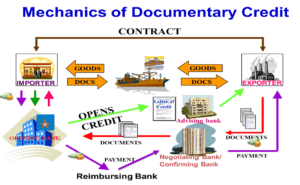
    PARTIES OF LETTER OF CREDIT

    Various parties of the LC are as under:

    1. Applicant

    The applicant is the party who opens the Letter of Credit. He is the buyer/importer of the goods (generally a borrower of the issuing bank). The applicant arranges to open a letter of credit with his bank as per the terms and conditions of the Purchase order and the business contract between buyer and seller. The applicant has to make a payment if documents as per LC are delivered, whether the goods are as per the contract between the buyer and beneficiary or not.

    1. Beneficiary party

    The seller or exporter is the beneficiary in whose favor the letter of credit is issued. It gets payment against documents as per LC from the nominated bank within the validity period for negotiation,

    1. Issuing Bank

    The issuing Bank is the bank that opens a letter of credit. The letter of credit is created by the issuing bank which takes responsibility for paying the amount on receipt of documents from the supplier of goods (beneficiary under LC).

    1. Advising Bank

    Advising bank, as a part of the letter of credit takes responsibility for communicating with necessary parties under letter of credit and other required authorities. The advising bank is the party that sends documents under the Letter of Credit to the opening bank. 

    1. Confirming Bank

    Confirming bank is a party to the letter of credit confirms and guarantees to undertake the responsibility of payment or negotiation acceptance under the credit. The bank which adds its guarantee to the LC opened by another Bank and thereby undertakes responsibility for payment/ acceptance/ negotiation/ incurring deferred payment under the credit in addition to that of the Issuing Bank. 

    1. Negotiating Bank 

    Negotiating Bank, who negotiates documents delivered to the bank by the beneficiary of LC. The negotiating bank is the bank that verifies documents and confirms the terms and conditions under LC on behalf of the beneficiary to avoid discrepancies.

    1. Reimbursing Bank

    The reimbursing bank is the party authorized to honor the reimbursement claim of negotiation/ payment/ acceptance.

    DIFFERENT TYPES OF LETTER OF CREDIT

    Different types of LCs are as under:

    Revocable & Irrevocable LCs

    A revocable letter of credit is one which can be cancelled or amended by the issuing bank at any time and without prior notice to or consent of the beneficiary. An Irrevocable Letter of Credit is one which cannot be cancelled or amended without the consent of all parties concerned. 

    According to the UCPDC 600, all LCs are irrevocable now, hence this type of revocable LC is obsolete. Irrevocable LC is a letter of credit that does not allow the issuing bank to make any changes without the approval of the beneficiary, applicant bank, and confirming bank, if any.

    Deferred or Usance LC & Sight LC

    A letter of credit, which ensures payment after a certain period. The date of payment is accepted by both buyer and seller. The bank may review the documents early but the payment to the beneficiary is made after the agreed time passes. It is also known as Usance LC.

    A letter of credit that demands payment on the submission of the required documents. The bank reviews the documents and pays the beneficiary if the documents meet the conditions of the letter.

    Restricted LC

    A restricted letter of credit refers to a letter of credit that restricts negotiation with the bank that the issuing bank has nominated in the credit. It is one wherein a specified bank is designated to pay, accept, or negotiate payment will be made. In a restricted negotiable letter of credit, the authorization from the issuing bank to pay the beneficiary is restricted to a specific nominated bank. An unrestricted letter of credit may be negotiated through any bank of the beneficiary’s choice.

    Transferable LCs

    It is an LC, where the beneficiary is entitled to transfer the LC, in whole or in part, to the 2nd beneficiary/s (supplier of the beneficiary). The 2nd beneficiary, however, cannot transfer it further, but it can transfer the unused portion, back to the original beneficiary. It is transferable only once.

    Back-to-Back Credit

    A pair of LCs in which one is to the benefit of a seller who is not able to provide the corresponding goods for unspecified reasons. In that event, a second credit is opened for another seller to provide the desired goods. Back-to-back is issued to facilitate intermediary trade. Intermediate companies such as trading houses are sometimes required to open LCs for a supplier and receive Export LCs from the buyer.

    Red Clause LC

    It refers to a packing or anticipatory credit, which has a clause permitting the correspondent bank in the exporter’s country to grant advance to the beneficiary at the issuing bank’s responsibility. These advances are adjusted from the proceeds of the bills negotiated.

    Green Clause LC

    It permits the advances for storage of goods in a warehouse in addition to pre-shipment advance. It is an extension of the red clause LC.

    Standby Credits

    It is similar to a performance bond or guarantee, but issued in the form of LC. The beneficiary can submit his claim using a draft accompanied by the requisite documentary evidence of performance, as stipulated in the credit.

    Documentary Credits

    When LC specifies that the bills drawn under LC must – accompany documents of title to goods such as RRs or MIRs or Bills of lading etc. it is termed as Documentary Credit. If any such documents are not called, the credit is said to be Clean Credit.

    Revolving Credits

    These LCs provide that the number of drawings made there under would be reinstated and made available to the beneficiary again and again for further drawings during the currency of credit provided the applicant makes the payment of documents earlier negotiated. At times, an overall turnover cap is also stipulated.

    PROCEDURE FOR OPENING LETTER OF CREDIT

    The buyer entered into a contract with an overseas supplier to import machinery at his factory. As per their contract, the buyer needs to open a Letter of credit (LC) in favor of the exporter/seller. Banker has to verify the following documents of the buyer/importer:

    • IEC No. of the buyer,
    • Whether Goods/Services under LC is permitted under Foreign Trade Policy or not,
    • Import License of the buyer if applicable,
    • FEMA Guidelines about the items imported.

    The customer’s financial standing, line of business, frequency of imports, sales, account turnover, satisfactory track record of the importer for import of goods, etc. are also scrutinized.

    SWIFT CODE

    SWIFT is the short form of “Society for Worldwide Interbank Financial Telecommunication”. In simple terms swift has two main roles in international financial transactions, firstly SWIFT provides a secure communications platform by which financial institutions can communicate with each other reliably & fast and secondly SWIFT establishes standard message formats that can be used on secure SWIFT platforms.

    Today banks use the SWIFT platform to communicate with each other when sending a wire transfer, issuing a letter of credit, advising a discrepancy message, etc. Each of these message formats has a different code, which is called swift message type.

    For example, a bank must use MT700 (MT means Message Type) Issue of a Documentary Credit when issuing a letter of credit and MT 734 advice of a refusal when giving its refusal message.

    According to the current letters of credit rules, UCP 600, a letter of credit will be deemed to be an operative letter of credit, if it is transmitted via an authenticated electronic platform such as SWIFT. 

    STANDARD FORMS OF DOCUMENTS

    When making payment for a product on behalf of its customer, the issuing bank must verify that all documents and drafts conform precisely to the terms and conditions of the letter of credit. Although the credit can require an array of documents, the most common documents that must accompany the draft include:

    Commercial Invoice

    The billing for the goods and services. It includes a description of merchandise, price, FOB origin, and name and address of buyer and seller. The buyer and seller information must correspond exactly to the description in the letter of credit. Unless the letter of credit specifically states otherwise, a generic description of the merchandise is usually acceptable in the other accompanying documents.

    Bill of Exchange

    This is a financial document. Payment is made on this document. In a letter of credit transaction, the right to draw a bill is conferred only on the beneficiary. The bill amount should be within the limit fixed in the letter of credit. The tenor, endorsement, and drawee should be the same as given in the letter of credit.

    Transport Documents

    The mode of dispatch of goods or the transporting of goods would depend on the terms of the contract between buyer and seller and the same is incorporated in the letter of credit. The two main modes of transport of goods are either by sea or by air. These are the important transport documents used in LC.

    • Bill of Lading

    A document evidencing the receipt of goods for shipment and issued by a freight carrier engaged in the business of forwarding or transporting goods. The documents evidence control of goods. They also serve as a receipt for the merchandise shipped and as evidence of the carrier’s obligation to transport the goods to their proper destination.

    • Airway Bill

    This is a document, which evidences that the goods have been received by an airline company or its agent. Unlike a bill of lading an airway bill does not carry with it the right to the goods, i.e., it is not a document of title to the goods.

    • Postal Parcel Receipt and Courier Receipts

    When the goods to be sent are small in quantity, then they can be sent through post or courier. The documents issued by the postal department or courier are similar in nature to the airway bill.

    Warranty of Title

    A warranty given by a seller to a buyer of goods that states that the title being conveyed is good and that the transfer is rightful. This is a method of certifying a clear title-to-product transfer. It is generally issued to the purchaser and issuing bank agreeing to indemnify and hold both parties harmless.

    Insurance Document

    The goods shipped, if required to be insured under the terms of the letter of credit should be so insured and the insurance document as required in the letter of credit should be enclosed with the other documents. The type of insurance cover should be the same as specified in the credit.

    Letter of Indemnity

    Specifically indemnifies the purchaser against a certain stated circumstance. Indemnification is generally used to guarantee that shipping documents will be provided in good order when available.

    RISKS IN LETTER OF CREDIT TRANSACTIONS

    Letter of credit transactions are not risk-free. The risks inherent in these types of transactions include:

    Fraud Risks: The payment will be obtained for non-existent or worthless merchandise against presentation by the beneficiary of forged or falsified documents. Credit itself may be funded.

    Sovereign and Regulatory Risks: The performance of the Documentary Credit may be prevented by government action outside the control of the parties.

    Legal Risks: Possibility that the performance of a documentary credit may be disturbed by legal action relating directly to the parties and their rights and obligations under the documentary credit.

    Force majeure risk: In which completion of the transaction is prevented by an external force, such as war or natural disaster

    INCOTERMS (INTERNATIONAL COMMERCIAL TERMS) 

    Incoterms are a set of rules that define the responsibilities of sellers and buyers for the delivery of goods under sales contracts. They are published by the International Chamber of Commerce (ICC) and are widely used in commercial transactions. Shippers worldwide use standard trade definitions (called Incoterms) to spell out who’s responsible for the shipping, insurance, and tariffs on an item; they’re commonly used in international contracts and are protected by the International Chamber of Commerce copyright. Incoterms significantly reduce misunderstandings among traders and thereby minimize trade disputes and litigation. Familiarize yourself with Incoterms so you can choose terms that will enable you to provide excellent customer service and clearly define who is responsible for which charges. 

    “Incoterms” is a registered trademark of the ICC. The first work published by the ICC on international trade terms was issued in 1923, with the first edition known as Incoterms published in 1936. The Incoterms rules were amended in 1953, 1967, 1976, 1980, 1990, and 2000, with the eighth version— Incoterms 2010.

    INCOTERMS 2020

    The International Chamber of Commerce (ICC) has already published Incoterms® 2020 rules that will be in effect as of January 1, 2020.  The latest version is that of Incoterms 2020 which is expected to be in effect for a decade, until December 2029.

    Incoterms® 2020 to choose are divided into four groups:

    1. E-Group (EXW)
    2. F-Group (FCA – FAS – FOB)
    3. C-Group (CPT – CIP – CFR – CIF)
    4. D-Group (DAP – DPU (Delivered at Place Unloaded) – DDP)

    RULES FOR ANY MODE OR MODES OF TRANSPORT

    EXW – Ex Works:

    “Ex Works” means that the seller delivers when it places the goods at the disposal of the buyer at the seller’s premises or another named place (i.e., works, factory, warehouse, etc.). The seller does not need to load the goods on any collecting vehicle, nor does it need to clear the goods for export, where such clearance is applicable.

    FCA – Free Carrier

    “Free Carrier” means that the seller delivers the goods to the carrier or another person nominated by the buyer at the seller’s premises or another named place. The parties are well advised to specify as clearly as possible the point within the named place of delivery, as the risk passes to the buyer at that point.

    CPT – Carriage Paid to

    “Carriage Paid To” means that the seller delivers the goods to the carrier or another person nominated by the seller at an agreed place (if any such place is agreed between parties) and that the seller must contract for and pay the costs of carriage necessary to bring the goods to the named place of destination.

    CIP – Carriage and Insurance Paid to

    “Carriage and Insurance Paid to” means that the seller delivers the goods to the carrier or another person nominated by the seller at an agreed place (if any such place is agreed between parties) and that the seller must contract for and pay the costs of carriage necessary to bring the goods to the named place of destination. The seller also contracts for insurance cover against the buyer’s risk of loss of or damage to the goods during the carriage. The buyer should note that under CIP the seller is required to obtain insurance only on minimum cover. Should the buyer wish to have more insurance protection, it will need either to agree as much expressly with the seller or to make its extra insurance arrangements.

    DAT – Delivered at Terminal

    “Delivered at Terminal” means that the seller delivers when the goods, once unloaded from the arriving means of transport, are placed at the disposal of the buyer at a named terminal at the named port or place of destination. “Terminal” includes a place, whether covered or not, such as a quay, warehouse, container yard or road, rail or air cargo terminal. The seller bears all risks involved in bringing the goods to and unloading them at the terminal at the named port or place of destination.

    DAP – Delivered at Place

    “Delivered at Place” means that the seller delivers when the goods are placed at the disposal of the buyer on the arriving means of transport ready for unloading at the named place of destination. The seller bears all risks involved in bringing the goods to the named place.

    DDP – Delivered Duty Paid

    “Delivered Duty Paid” means that the seller delivers the goods when the goods are placed at the disposal of the buyer, cleared for import on the arriving means of transport ready for unloading at the named place of destination. The seller bears all the costs and risks involved in bringing the goods to the place of destination and should clear the goods not only for export but also for import, to pay any duty for both export and import, and to carry out all customs formalities.

    RULES FOR SEA AND INLAND WATERWAY TRANSPORT

    FAS – Free Alongside Ship

    “Free Alongside Ship” means that the seller delivers when the goods are placed alongside the vessel (e.g., on a quay or a barge) nominated by the buyer at the named port of shipment. The risk of loss of or damage to the goods passes when the goods are alongside the ship, and the buyer bears all costs from that moment onwards.

    FOB – Free On Board

    “Free On Board” means that the seller delivers the goods on board the vessel nominated by the buyer at the named port of shipment or procures the goods already so delivered. The risk of loss of or damage to the goods passes when the goods are on board the vessel, and the buyer bears all costs from that moment onwards.

    CFR – Cost and Freight

    “Cost and Freight” means that the seller delivers the goods on board the vessel or procures the goods already so delivered. The risk of loss of or damage to the goods passes when the goods are on board the vessel. the seller must contract for and pay the costs and freight necessary to bring the goods to the named port of destination.

    CIF – Cost, Insurance and Freight

    “Cost, Insurance, and Freight” means that the seller delivers the goods on board the vessel or procures the goods already so delivered. The risk of loss of or damage to the goods passes when the goods are on board the vessel. The seller must contract for and pay the costs and freight necessary to bring the goods to the named port of destination. The seller also contracts for insurance cover against the buyer’s risk of loss of or damage to the goods during the carriage. The buyer should note that under CIF the seller is required to obtain insurance only on minimum cover. Should the buyer wish to have more insurance protection, it will need either to agree as much expressly with the seller or to make extra insurance arrangements.

    UCPDC (UNIFORM CUSTOMS AND PRACTICE FOR DOCUMENTARY CREDITS) 600

    This revision of the Uniform Customs and Practice for Documentary Credits (commonly called “UCP”) is the sixth revision of the rules since they were first promulgated in 1933. It is the fruit of more than three years of work by the International Chamber of Commerce’s (ICC) Commission on Banking Technique and Practice. UCP 600 is the latest revision of the Uniform Customs and Practice that governs the operation of letters of credit. UCP 600 comes into effect on 01 July 2007. The 39 articles of UCP 600 are a comprehensive and practical working aid to bankers, lawyers, importers, exporters, transport executives, educators, and everyone involved in letter of credit transactions worldwide.

    COMMON DEFECTS IN DOCUMENTATION

    About half of all drawings presented contain discrepancies. A discrepancy is an irregularity in the documents that causes them to be in non-compliance to the letter of credit. Requirements outlined in the letter of credit cannot be waived or altered by the issuing bank without the express consent of the customer. The beneficiary should prepare and examine all documents carefully before presentation to the paying bank to avoid any delay in receipt of payment. Commonly found discrepancies between the letter of credit and supporting documents include:

    • The letter of Credit has expired before the presentation of the draft.
    • Bill of Lading evidences delivery before or after the date range stated in the credit.
    • Stale-dated documents.
    • Changes included in the invoice are not authorized in the credit.
    • Inconsistent description of goods.
    • Insurance document errors.
    • The invoice amount is not equal to the draft amount.
    • Ports of loading and destination are not as specified in the credit.
    • The description of the merchandise is not as stated in credit.
    • A document required by the credit is not presented.
    • Documents are inconsistent as to general information such as volume, quality, etc.
    • Names of documents are not exactly as described in the credit. Beneficiary information must be exact.
    • The invoice or statement is not signed as stipulated in the letter of credit.

    When a discrepancy is detected by the negotiating bank, a correction to the document may be allowed if it can be done quickly while remaining in the control of the bank. If time is not a factor, the exporter should request that the negotiating bank return the documents for corrections.

  • LAWS RELATING TO BILL FINANCE

    LAWS RELATING TO BILL FINANCE

    INTRODUCTION

    Bill finance is one of the major activities of the Banks. Under this type of lending, the Bank takes the bill drawn by the borrower on his (borrower’s) customer and pays him immediately deducting some amount as a discount/commission. The Bank then presents the Bill to the borrower’s customer on the due date of the Bill and collects the proceeds. If the bill is delayed, the borrower or his customer pays the Bank a pre-determined interest depending upon the terms of the transaction. The transaction is practically an advance against the security of the bill which is due for payment.

     BILL OF EXCHANGE

    Section 5 of the NI Act defines, “A bill of exchange is an instrument in writing containing an unconditional order, signed by the maker, directing a certain person to pay a certain sum of money only to, or to the order of a certain person or to the bearer of the instrument”.

    A bill of exchange, therefore, is a written acknowledgement of the debt, written by the creditor and accepted by the debtor. There are usually three parties to a bill of exchange drawer, the acceptor or drawee and payee. Drawer himself may be the payee.

     ESSENTIAL CONDITIONS OF A BILL OF EXCHANGE

    (1) It must be in writing.

    (2) It must be signed by the drawer.

    (3) The drawer, drawee and payee must be certain.

    (4) The sum payable must also be certain.

    (5) It should be properly stamped.

    (6) It must contain an express order to pay money and money alone.

    For example, in the following cases, there is no order to pay, but only a request to pay. Therefore, none can be considered as a bill of exchange:

    (a) “I shall be highly obliged if you make it convenient to pay Rs. 1000 to Suresh”.

    (b) “Mr. Ramesh, please let the bearer have one thousand rupees, and place it to my account and oblige” However, there is an order to pay, though it is politely made, in the following examples:

    (a) “Please pay Rs. 500 to the order of ‘A’.

    (b) ‘Mr. A will oblige Mr. C, by paying to the order of’ P”.

    (7) The order must be unconditional.

    PARTIES TO A BILL OF EXCHANGE

    Section 7 of the NI Act defines different parties of the bill of exchange.

    1. Drawer: The maker of a bill of exchange is called the ‘drawer’.
    1. Drawee: The person directed to pay the money is called the ‘drawee’,
    1. Acceptor: After a drawee of a bill has signed his assent upon the bill, or if there are more parts than one, upon one of such parts and delivered the same, or given notice of such signing to the holder or to some person on his behalf, he is called the ‘acceptor’.
    1. Payee: The person named in the instrument, to whom or to whose order the money is directed to be paid by the instrument is called the ‘payee’. He is the real beneficiary under the instrument.
    1. Endorser: When the holder transfers or endorses the instrument to anyone else, the holder becomes the ‘Endorser’.
    1. Endorsee: The person to whom the bill is endorsed is called an ‘Endorsee’.
    1. Holder & Holder in Due Course: A person who is legally entitled to the possession of the negotiable instrument in his name and to receive the amount thereof, is called a ‘holder’. ‘Holder in Due Course’ means any person who for consideration became the possessor of the bill (that is a person to whom the bill is transferred).
    1. Acceptor for honour: In case the original drawee refuses to accept the bill or to furnish better security when demanded by the notary, any person who is not liable for the bill, may accept it with the consent of the holder, for the honour of any party liable on the bill. Such an acceptor is called an ‘acceptor for honour’.

    CLASSIFICATION OF BILLS

    Bills can be classified as:

    (1) Inland and foreign bills (Place wise)

    (2) Time and demand bills (Period wise)

    (3) Trade and accommodation bills (Nature wise)

    (4) Clean and documentary bills (Documents wise)

    (1) Inland and Foreign Bills

    Inland bill: A bill is, named as an inland bill if drawn and made payable in India. A bill drawn or made in India & payable in or drawn upon any persons in India. The necessary requirements for inland bills are:

    (a) It must be drawn in India on a person residing in India, whether payable in or outside India, or

    (b) It must be drawn in India on a person residing outside India but payable in India.

    The following are examples of Inland bills

    (i) A bill is drawn by a merchant in Delhi on a merchant in Madras. It is payable in Bombay.

    (ii) A bill is drawn by a Delhi merchant on a person in London but is made payable in India.

    (iii) A bill is drawn by a merchant in Delhi on a merchant in Madras. It is accepted for payment in Japan.

     Foreign Bill: A bill which is not an inland bill is a foreign bill. The following are the foreign bills:

    1. A bill drawn outside India and made payable in India.
    2. A bill drawn outside India on any person residing outside India.
    3. A bill drawn in India on a person residing outside India and made payable outside India.
    4. A bill drawn outside India on a person residing in India.
    5. A bill drawn outside India and made payable outside India.

     Bill of exchange in sets: When the bills are in sets, (i.e. first, second or third copy) as in the case of foreign trade transactions, the stamp duty is paid only on one part and only one part is required to be accepted.

    Bills in sets (Secs. 132 and 133): The foreign bills are generally drawn in sets of three, and each set is termed as a ‘via’. The stamp duty is paid only on one part and only one part is required to be accepted. As soon as any of the sets is paid, the others become inoperative. These bills are drawn in different parts. They are drawn to avoid their loss or miscarriage during transit. Each part is dispatched separately. To avoid delay, all the parts are sent on the same day; by different modes of conveyance.

     (2) Time and Demand Bill

    Time or Usance bills: A bill payable after a fixed time is termed as a time bill. In other words, bill payable “after date” is a time or usance bill.

    Demand bill: A bill payable at sight or on demand is termed as a demand bill.

     (3) Trade and Accommodation Bill

    Trade bill: A bill drawn and accepted for a genuine trade transaction is termed as a “trade bill”.

    Accommodation bill: A bill drawn and accepted not for a genuine trade transaction but only to provide financial help to some party is termed an “accommodation bill”.

    Example: A, requires money for three months. He induces his friend B to accept a bill of exchange drawn on him for Rs. 1,000 for three months. The bill is drawn and accepted. The bill is an “accommodation bill”. A may get the bill discounted from his bankers immediately, paying a small sum as a discount. Thus, he can use the funds for three months and then just before maturity, he may remit the money to B, who will meet the bill on maturity. In the above example, A is the “accommodated party” while B is the “accommodating party”.

     (4) Clean and documentary bills

    Clean bills: A clean bill is a bill of exchange drawn as per requirements of the NI Act and is not supported by documents of title of goods. Clean bills are drawn normally to effect the discharge of a debt or claim.

    Documentary bills: A bill of exchange accompanying documents of title of goods is called a documentary bill. These bills are drawn to claim the price of goods supplied. Examples of title of goods are Railway receipts, warehouse receipts, bills of lading, dock warrants etc.

    Stamp duty on bills: The advalorem stamp duty is payable on usance bill (i.e. as per amount and usance period). Following usance bills are exempted from payment of stamp duty (a) with a usance period of up to 90 days, where the bank is a party to the bill since 1989 (b) export bills 2004. On-demand bills, the stamp duty is exempted.

     Acceptance of a bill of exchange: The acceptance of a bill means signing by the drawer of a bill, on the face with or without the words accepted and delivery thereof or giving notice of signing, to the holder of the bill. There are 2 types of acceptances i.e. general acceptance and qualified acceptance. In cages of several drawees not being partners, each of them can accept it for himself but not others without their authority (Sec 34).

     Dishonour of bill of exchange: A bill of exchange is said to be dishonoured either by non-acceptance (when the drawee defaults in acceptance) or by non-payment (when the acceptor/drawee makes default in payment). Similarly, where the drawee is incompetent to contract or acceptance is qualified, the bill is said to be dishonoured (Sections 91 & 92).

     Notice of dishonour: When a bill is dishonoured, the holder thereof must give notice that the instrument has been so dishonoured to all parties whom the holder seeks to make jointly liable thereon. It is not necessary to give notice to the maker of the dishonoured promissory note, or the drawee or acceptor of the dishonoured bill of exchange or cheque (Section 93).

     Presentation for acceptance: As per Section 61, a usance bill payable after sight and bills payable on a fixed date (and not demand bills) are required to be presented to the drawee for acceptance to make him liable and also for calculation of the due date.

      RULES FOR DUE DATE CALCULATION

    • A Demand bill is payable on demand or at sight.
    • A Usance bill should be presented for acceptance within a reasonable time.
    • The drawee is allowed 48 hours excluding public holidays to accept the bill.
    • If a usance bill is payable after the date, its due date is calculated from the date of the bill and if it is payable after sight, its due date is calculated from the date of acceptance.
    • A 3-day grace period is given to every Usance Promissory Note or BOE.
    • Where the due date is already given by the drawer, no grace period is to be given.
    • Instruments payable in instalments, the days of grace are to be allowed for each instalment.
    • When the maturity date is a public holiday: As per sec 25 of the N I Act, such instrument be payable on the next preceding business day i.e. the previous business day.
    • Declaration of Public Holiday: u/s 25 of N I Act 1881, the public holiday includes Sunday and any other day declared by the Central Govt. by notification in the Official Gazette (this power has been delegated to the state government).
    Date of bill Presented on Accepted on Payment terms Due date
    26.02.24 27.02.24 28.02.24 30 days after acceptance. 01.04.24
    26.12.23 26.12.23 28.12.23 45 days after the date. 12.02.24
    20.12.23 21.12.23 23.12.23 1 month after sight. 25.01.24
    26.02.24 27.02.24 28.02.24 3 months after acceptance. 31.05.24
    26.12.23 26.12.23 28.12.23 2 months after date. 29.02.24

    TYPES OF BILL FINANCE

    A banker offers the following types of bill finance:

    1. Bill Purchase (B.P.)
    2. Bill Discount (B.D.)
    3. Advance against Bill for Collection (A.B.C.)
    1. Bill Purchase

    When a bank negotiates bills payable on demand, whether clean or documentary, the facility is known as bill purchase. The face value of the bill is immediately paid to the holder. The bank after purchasing the bill, becomes the holder in due course of the bill and acquires all the rights of ownership over the instrument. Bill purchase facility is extended generally in the case of bills payable on demand. However, in the case of usance bills also this is extended when the due date of the bill is not readily known at the time of extending the facility. Such a situation arises when the bill is drawn payable after some days after sight. The due date of such a bill is known when the bill is presented to the drawee and the period of usance commences from the date of presentation. In the case of a demand bill, the date on which it will be paid is uncertain. The drawee may pay the bill as soon as it is presented to him or he may take a few days to do so. Hence, as in the case of cheque purchase, interest for the estimated time for realization of the bill, say for 15 days, is recovered at the time of purchase. Additional interest is recovered or excess interest refunded on realization of the bill according to the actual number of days taken to realize the bill. In case of dishonour of the bill, the amount is recovered from the customer.

    1. Bill Discount

    In the case of a Usance Bill, the date of payment is certain as it becomes payable a certain number of days after it is accepted or from the date of the bill. Hence we may be able to calculate the exact amount of interest due on the bill and recover it upfront. Interest recovered at the time of advance is called a “discount”. When money is against a usance bill for collection, it is called Bill Discounting. In the case of bills purchase also interest is recovered at the time of advance. However, it is only an estimated amount and not the exact amount due. Hence it is called commission and not discount.

    1. Advance against Bill for Collection

    Banks also give advance against the bills, which are in the course of the collection known as an advance against the bill for collection. Under this facility, a prescribed margin is kept by the bank and the amount, in consideration of this is allowed to the customer. The bill thereafter is sent for collection.

    In all cases, the legal effect is that the banker, who lends money, becomes the holder in due course the bill.

    Bills Discounting and Purchase are less risky than CC facility for the following reasons:

    Self-Liquidating – Bills will be repaid when the buyer pays the bills on the due date.

    Easy to monitor – If the bill is not paid on the due date it will be known immediately and the bank can speedily take further action for recovery of the advance.

    More secure – The goods covered by demand bills can be taken delivery of by the buyer only after paying the bill. Hence, if the bill is not repaid the bank can take delivery of the goods and sell it to recover the advance. In the case of a usance bill, the bank can proceed against the seller and the buyer for recovery. Further, since a bill is a negotiable instrument, on filing a suit, consideration need not be proved.