Archives: Blogs

  • The Key Differences Between Capital and Revenue Receipts

    The Key Differences Between Capital and Revenue Receipts

    INTRODUCTION

    Accounting aims to ascertain the financial performance of a firm. To do so the transactions have to be identified as capital or revenue in nature. This will determine whether they are placed in the Profit and Loss Account or the Balance Sheet. Let us study about capital and revenue expenditure and receipts.

    EXPENDITURE

    Expenditure means spending on something. This can be a payment in cash or can also be the exchange of some valuable item in exchange for goods or services. It is the process of causing a liability by a commodity. Receipts and invoices keep the records of expenditures. An expense is a word very similar to expenditure but expense shows the deduction in the value of the asset while expenditure simply denotes the obtaining of assets.

    Determining Capital Nature and Revenue Nature

    There are certain basic considerations when we are determining the nature of a financial transaction, i.e. capital nature or revenue nature. Some such considerations are as follows.

    1. Nature of Business: The capital or revenue nature is dependent on the type of business a person does. It is different for different types of business. For instance, a business that provides car insurance to people comes under the revenue nature but the manufacturer buying the machinery for his factory is capital expenditure.

    2. Recurring Nature of Expenditure: As stated earlier, revenue nature expenditures are recurring in nature, and capital nature expenditures are non-recurring in nature.

    3. Purpose of Expenditure: The manufacturing process is an illustration of capital nature while renovation and repairing processes are expenses of a revenue nature.

    Two types of expenditures are present based on time durations, That is:

    1. Capital expenditures
    2. Revenue expenditures 
    1. Capital Expenditure

     Whenever a business spends money it receives some form of value representing goods or services, but the items which are purchased will be of benefit to the business for varying lengths of time. The fixed assets purchased by a firm are primarily intended for long-term use in the business, and will usually be retained by the business for some considerable time. Fixed assets consist of land, buildings, plant and machinery, furniture and fittings, office equipment, motor vehicles, and all other assets which are purchased for use in the business. The assets possessed by a firm will generally be used in the business over long periods, and will permanently increase the profit-making capacity of the business.

    Capital expenditure, therefore, can be defined as: “Expenditure on the purchase of fixed assets, or expenditure to increase the value of an existing fixed asset. Capital expenditure will increase the assets possessed by a firm and will appear on the balance sheet”.

    1. Revenue Expenditure

    These are the costs incurred during the day-to-day running of a business. They include all such items as salaries, wages, telephone, lighting and heating, rent, interest rates, insurance, discounts allowed, carriage costs, and so on. These are costs for the services received, and the payments made for expenses incurred by the business, and form part of the expenditure involved in the daily routine operation of running a business; they will only be of benefit for a short period. The costs involved are ‘used up’, usually in less than a year, and they will only be temporary.

    Difference between Capital Expenditure and Revenue Expenditure

    Capital Expenditure

    Revenue Expenditure

    1. Its effect is long-term, i.e. it is not exhausted within the current accounting year. Its benefit will be received for several years in the future. 1. Its effect is temporary, i.e. the benefit is received within the accounting year.
    2. An asset is acquired or the value of an existing asset is increased. 2. Neither an asset is acquired nor is the value of an asset increased.
    3. Generally, it has a physical existence except for intangible assets. 3. It has no physical existence because it is incurred on items that are used by the business.
    4. It does not occur again and again. It is nonrecurring and irregular. 4. It is recurring and regular and it occurs repeatedly.
    5. This expenditure improves the position of the business. 5. This expenditure helps to maintain the business.
    6. A portion of this expenditure (depreciation on assets) is shown in trading & P & L A/c and the balance is shown in the balance sheet on the asset side. 6. The whole amount of this expenditure is shown in trading P & L A/c or income statement.
    7. It appears in the balance sheet until its benefit is fully exhausted. 7. It does not appear in the balance sheet.
    8. It does not reduce the revenue of the concern. The purchase of fixed assets does not affect revenue. 8. It reduces the revenue (profit) of the business.

    Deferred Revenue Expenditure

    Deferred revenue expenditure is the expenditure which is originally revenue in nature but the amount spent is so large that the benefit is received for not a year but for many years. A proportionate amount is charged to the profit and loss account of each year and the balance is carried forward to subsequent years as deferred revenue expenditure. It is shown as an asset in the balance sheet, e.g., heavy expenditure incurred on advertisements.

    RECEIPT

    Capital receipt and revenue receipt, both are very important components of accounting. It is important to correctly differentiate between the two. Classification of these transactions is reflected in the final statements of the company.

    Capital receipts

    Capital receipts are the receipts that are not received in the ordinary course of business. These are non-recurring receipts. Money obtained from the sale of fixed assets or investments, the issue of shares or debentures, and loans taken are some examples of capital receipts. Capital receipts are shown as liability reduced from assets appearing in the balance sheet.

    Revenue Receipts

    Revenue receipts are receipts obtained in the normal course of business. It is a receipt against the supply of goods or services. The money obtained from sales, interest, dividends, transfer fees, etc. are examples of revenue receipts. Revenue receipts are credited to the profit and loss account.

    The distinction between Capital Receipt and Revenue Receipt

    Capital Receipt

    Revenue Receipt

    1. It has long-term effects. The benefit is enjoyed for many years in the future. 1. It has short-term effects. The benefit is enjoyed within one accounting period.
    2. It does not occur again and again. It is nonrecurring and irregular. 2. It occurs repeatedly. It is recurring and regular.
    3. It is shown in the Balance Sheet on the liability side. 3. It is shown in the profit and loss account on the credit side.


    4. Capital receipt, when invested, produces revenue receipt e.g. when capital is invested by the owner, the business gets revenue receipt (i.e. sale proceeds of goods etc.). 4. It does not produce a capital receipt.
    5. The capital receipt decreases the value of an asset or increases the value of liability e.g. sale of a fixed asset, loan from a bank, etc. 5. This does not increase or decrease the value of assets or liability.


    6. Sometimes expenses of a revenue nature are to be incurred for such receipt e.g. on obtaining a loan (a capital receipt) interest is paid until its repayment. 6. Sometimes, expenses of a capital nature are to be incurred for revenue receipt, e.g. purchase of shares of a company is capital expenditure but the dividend received on shares is a revenue receipt.

  • DEPRECIATION OF ASSETS (DEFINITION AND METHODS WITH EXAMPLES)

    DEPRECIATION OF ASSETS (DEFINITION AND METHODS WITH EXAMPLES)

    MEANING OF DEPRECIATION

    Depreciation is the reduction in the value of assets due to wear and tear. It is a method of allocation of the cost of the asset over its useful life. Every asset is subject to wear and tear in the normal course of its use and also over time. The cost of the asset is allocated over time and considered as an expense.

    Depreciation is a method of reallocating the cost of a tangible asset over its useful life span of it being in motion. In accounting terms, depreciation is defined as the reduction of the recorded cost of a fixed asset in a systematic manner until the value of the asset becomes zero or negligible.

    Generally, the cost is allocated, as depreciation expense, among the periods in which the asset is expected to be used. An example of fixed assets are buildings, furniture, office equipment, machinery, etc.. The land is the only exception that cannot be depreciated as the value of land generally appreciates with time.

     CAUSES OF DEPRECIATION

    Depreciation is a value reduction in the carrying amount of a fixed asset. Depreciation is intended to roughly reflect the actual consumption of the underlying asset so that the carrying amount of the asset has been greatly reduced to its salvage value by the time its useful life is over.

    The term depreciation represents loss or diminution in the value of an asset consequent upon wear and tear, obsolescence, effluxion of time, or permanent fall in market value. The causes of depreciation are:

    1. Wear and Tear: Some assets physically deteriorate due to wear and tear in use. When an asset is constantly used for production, the asset wears out. More and more use of an asset, the greater would be the wear and tear. Physical deterioration of an asset is caused from movement, strain, friction, erosion etc. For instance, building, machineries, furniture, vehicles, plant etc. The wear and tear is general but pri­mary cause of depreciation.
    2. Lapse of Time: There are certain assets like leasehold property, patents, copy-right etc. that are acquired for a particular period. After the expiry of the period, they are rendered useless i.e. their value ceases to exist. Thus, their cost is written off over their legal life.
    3. Obsolescence: A new and improved machine performs the same function more quickly and cheaply than the existing ma­chine. As such, existing machine may become out of date or outmoded or obsolete. The new inventions, change in fashions and taste, market condition etc. are the causes to discard the value of an asset.
    4. Exhaustion: Some assets are of wasting nature. For instance, quarries, mines, oil-well etc. It is the reduction in the value of natural deposits as resources have been extracted year after year. As such these assets are known as wasting assets. The coalmine or oil well gets physically exhausted by the removal of its contents.
    5. Maintenance:A good maintenance of machine will naturally increase its life. When there is no maintenance, there is more depreciated value. When there is good maintenance, there is longer life to the machines. The long life of machine depends upon good and skilled maintenance.

    When there is damage to or impairment of an asset, it can be considered a cause of depreciation, since either event changes the amount of depreciation remaining to be recognized.

    Only in a few cases do assets appreciate. Land, gold, antique goods and old paintings may go up in value. But, usually the value of an asset diminishes continuously.

     NEED FOR DEPRECIATION:

    Depreciation is provided for the assets with a view to achieve the following results:

    1. To ascertain the true profit: Asset is an important tool in earning revenues. When the value of assets decreases, this loss must be brought into account; otherwise a true working result cannot be known. Depreciation is an operating expense of a physical asset, the same should be considered in arriving the true profit earned during each year.If depreciation is ignored, the loss that is occurring in respect of fixed assets will be ignored. So, depreciation should be debited to Profit and Loss Account before profit is ascertained.
    2. To Ascertain True Value of Asset: The function of the Balance Sheet is to show the true and correct view of the state of affairs of a business. If no depreciation is charged and when assets are shown at the original cost year after year, Balance Sheet will not disclose the correct state of affairs of a business.
    3. To Retain Funds for Replacement: Assets used in the business need replacement after the expiry of their service. When an asset is continuously used, a time will come when the asset is to be given up and hence its replacement is essential.Therefore, it is necessary to make provision and create funds to replace such assets, in proper time.
    4. To Reduce Tax Liability: Depreciation is a tax deductible expense. As such, it is permitted by the prevailing taxation laws to be deducted from profit. Consequently, the owner of a business may avail himself of this benefit by charging depreciation to his profit and reducing his tax liability.
    5. To Present True Position: Financial position can be studied from the Balance Sheet and for the preparation of the Balance Sheet fixed assets are required to be shown at their true value. If assets are shown in the Balance Sheet without any charge made for their use, (that is, depreciation) then their value must have been over­stated in the Balance Sheet and will not reflect the true financial position of the business.

    Consequences of Not Providing for Depreciation: If depreciation is not accounted for, the profit of the company is overstated, In turn, it is distrib­uted among the shareholders. Thus there is no provision for the replacement of the machine. It must be pointed out that depreciation by itself does not create funds; it merely draws attention to the fact that out of gross revenue receipts, a certain amount should be retained to replace the asset used for carrying on activities. It is mandatory to charge depreciation in the profit and loss account in the Companies Act 2013. The Companies Act makes it compulsory to write off depreciation on fixed assets before declaring dividends.

     FACTORS OF DEPRECIATION

    Depreciation is an allowable expense in general accounting purposes and income tax accounting purposes. But it differs categorically from other conventional expenses because depreciation charges do not occur in any outflow of business funds.

    The periodical amount of depreciation is affected by the following factors:

    1. The Cost of the Asset: Cost of the asset means the basic acquisition cost of the asset plus all incidental expenses which are required to the asset into use. The incidental expenses like freight, import duty, brokerage, taxes, legal expenses and installation charges also form a part of cost of asset.
    2. The Life of the Asset: This is the period over which the organisation considers the fixed asset to be productive. Beyond its useful life, the fixed asset is no longer cost-effective to continue the operation of the asset.
    3. The Salvage Value of the Asset: Post the useful life of the fixed asset, the company may consider selling it at a reduced amount. This is known as the salvage value of the asset.
    4. Method of Depreciation: By the method of depreciation selected for amortisation of the asset must be systematic and rational.

     ACCOUNTING FOR DEPRECIATION

    Depreciation is an expense and reduces the book value of the asset. Therefore, a simple journal entry is to be passed at the end of the year. Journal entry for depreciation depends on whether the provision for depreciation / accumulated depreciation account is maintained or not. 

    Assets such as plant and machinery, buildings, vehicles, furniture etc. which are expected to last more than one year, but not for an infinite number of years are subject to depreciation. The below journal entry for depreciation assumes that depreciation is charged directly to the asset account. 

    Journal entry for depreciation;

    Depreciation A/C Debit
     To Asset A/C Credit

    (Assuming no provision/accumulated depreciation account is maintained)

    The golden rules of accounting applied in the above journal entry are;

    • Depreciation– Nominal Account > Dr. All expenses & losses
    • Asset– Real Account > Cr. What goes out

     To Transfer Depreciation into P&L

    Profit & Loss A/C Debit
     To Depreciation A/C Credit

    After the asset’s useful life when all depreciation is charged throughout the years, the asset approaches it scrap or residual value.

    Thus, depreciation is shown as an indirect expense in the debit side of the profit and loss account and the asset’s value is to be shown after the reduction of depreciation in balance sheet.

    There is also a method of accounting for depreciation, although it is rarely used. In this method rather than reducing the value of asset another account is credited named as accumulated depreciation and depreciation for all assets are transferred into it. It is then shown as negative item in the fixed asset balance sheet.

    Example: Let’s assume that a piece of machinery worth Rs. 1,00,000 is charged depreciation (Straight line method) at 10%. The journal entry will be;

    Depreciation A/C 10,000
     To Machinery A/C 10,000

     To Transfer it to the Income Statement

    Profit & Loss A/C 10,000
     To Depreciation on Machinery A/C 10,000

    METHOD OF DEPRECIATION

    There are three methods commonly used to calculate depreciation. They are:

    • Fixed Percentage Method or Straight-Line Method
    • Diminishing Value Method or Written Down Value (WDV) Method
    • Units of Production Method
    • Sum of the Years’ Digits Method of Depreciation

     1. FIXED PERCENTAGE METHOD OR STRAIGHT-LINE METHOD

    The simplest, most used and popular method of charging depreciation is the straight-line method. The Straight-Line Method of depreciation is also known as the ‘Original Cost Method’, ‘Fixed Instalment Method’ and ‘Fixed Percentage Method’.

    Under this method, an equal amount is provided each year for the depreciation of each asset until the asset has been written down to nil or its scrap value at the end of the estimated life of the asset. The name of this method is derived from the fact if the successive annual depreciation over the life of the asset is plotted on a graph, the result will be a straight line with a slope equal to the annual depreciation. This method is also called the ‘Fixed Instalment Method’ because a uniform amount of depreciation is charged each year. Straight-line depreciation can be calculated by using the following formulas:

    Depreciation Amt = (Cost of asset − Salvage Value) ∕ Useful life in years

    The formula of the annual depreciation under the method is;

    Depreciation per annum = (Cost of asset − Salvage Value) x Rate of depreciation

    1. Example: Suppose a business has bought a machine for Rs. 10,000. They have estimated the useful life of the machine to be 8 years with a salvage value of Rs. 2,000.

    Solution:

    Now, as per the straight-line method of depreciation:

    Cost of the asset = Rs. 10,000 and Salvage Value = Rs. 2000

    Total Depreciation Cost = Cost of asset – Salvage Value = 10000 – 2000 = Rs. 8000

    Useful life of the asset = 8 years

    Thus, annual depreciation cost = (Cost of asset – Salvage Cost)/Useful Life = 8000/8 = Rs. 1000

    Hence, the Company will depreciate the machine by Rs.1000 every year for 8 years.

    1. Example: On 1 Jan 2016, Company A purchased a vehicle costing Rs.20,000. The company expects the vehicle to be operational for 4 years at the end of which it can be sold for Rs.5,000. Calculate depreciation expense for the year ended 31 Dec 2016, 2017, 2018 and 2019.

    Solution:

    Depreciable amount of the vehicle is Rs.15,000 (Rs.20,000 cost minus Rs.5,000 salvage value). Useful life is 4 years.

    Depreciation expense for year ended 31 Dec 2016 = Rs.15,000 ÷ 4 = Rs.3,750 per year.

    Depreciation expense shall remain the same over the useful life. Hence, an amount of Rs.3,750 shall be the depreciation expense for year ended 31 Dec 2017, 2018 and 2019.

    The advantages of Straight-Line Method are;

    1. Simple and easy to understand.
    2. The book value of an asset can be reduced to Zero.
    3. A fair evaluation ofan asset each year on the balance sheet.

    Disadvantages of Straight-Line Method are;

    a) The depreciation is equal for all the years. However, the expenditure on repairs and renewal goes on increasing as the asset gets older, resulting in higher amount charged to profit and loss account on account of depreciation and repairs in the subsequent years.

    2. DIMINISHING VALUE OR WRITTEN DOWN VALUE (WDV) METHOD

    The second type of depreciation method is the diminishing value method which is also known as ‘Written down value method’, ‘Reducing instalment method’, and ‘Fixed percentage on diminishing balance’.Written down value (WDV) method of depreciation is the most commonly used method of depreciation. In Income Tax Act, depreciation is allowed as per the WDV method.

    According to the diminishing value method, depreciation is charged on reducing balance & a fixed rate. Depreciation, in this case, is charged over the useful life of an asset over its written down value.The percentage, at which depreciation is charged, remains fixed, however, the amount of depreciation goes on diminishes year after year. More depreciation tends to occur earlier in asset’s life.

    This method is more relevant where the particular asset (viz; Vehicle, Computer, Office Equipment, etc.) is expected to give better performance in the initial periods of use as compared to the later. Thus, the charge of P&L account is higher in the initial year as compared to the later year of the life of such asset.

    Annual Depreciation = Previous year’s value (WDV) x Percentage rate 

    For example- Asset is purchased at Rs. 1,00,000 and the depreciation rate is 10% then first-year depreciation is Rs. 10,000 (10% of Rs. 1,00,000), second year depreciation is Rs. 9,000 (10% of 90,000 [1,00,000 – 10,000]) and third year depreciation is Rs. 8,100 (10% of Rs. 81,000 [90,000 – 9,000]).

    1. Example: A machine was purchased for Rupees 1,00,000, the estimated useful life of which is 8 years. The estimated salvage value of the machine at the end of its useful life is Rs. 20,000. It was decided to charge depreciation at 10% every year on the written-down value of the machine.

    The results under the written down value method after charging depreciation for 8 years will be as shown in the table below:

    Year Cost/WDV Depreciation @ 10% on WDV Net Book Value (at the end of the year)
    1 1,00,000 10,000 90,000
    2 90,000 9,000 81,000
    3 81,000 8,100 72,900
    4 72,900 7,290 65,610
    5 65,610 6,561 59,049
    6 59,049 5,905 53,144
    7 53,144 5,314 47,830
    8 47,830 4,783 43,047

    In the example we discussed in the straight-line methods of depreciation, we saw that, at the end of the 8th year, using the straight-line method, only Rs. 20,000 (that is the Salvage value) was left to be written off. However, in the present scenario when we are using the written-down value method of depreciation, the net book value of the Asset at the end of the 8th year is Rs. 43,047. There is still an amount of Rupees (43047 – 20000) = 23047 left to be written off.

    Hence a higher percentage rate is needed to reduce the Asset to its disposable value in a given time under the written down value method. This is because the fixed rate of depreciation is applied to the written down value or the diminishing balance of the Asset instead of the original cost of the asset as it was done in the straight-line method of depreciation. It is for the same reason that the diminishing balance method or the written down value method will never reduce an asset to zero net book value.

    Advantages of Written Down Value Method: The following are the advantages of this method:

    1. It matches the service of the asset with the depreciation charge. When an asset is more efficient in the initial years, higher depreciation is charged compared to later years. It is true about fixed assets such as motor vehicles.
    2. It recognizes the risk of obsolescence by charging the major part of depreciation in the early years of the life of the asset.
    3. It results in a better cash flow through tax deferral as under this method, the net income to be taxed is lower in the initial years and higher in subsequent years.
    4. As and when additions are made to the asset, fresh calculations of depreciation are not necessary.
    5. Income-tax authorities recognize this method.

    Disadvantages of the Written Down Value Method: The main drawbacks of this method are as follows:

    1. In subsequent years the original cost of the asset is completely lost sight of.
    2. The asset can never be reduced to zero.
    3. This method does not take into consideration the interest on capital invested in the asset.
    4. This method requires elaborate bookkeeping. The determination of the correct rate of depreciation is a complex task. 

    3. UNITS OF PRODUCTION METHOD

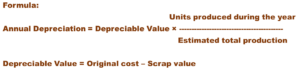
    This method of charging depreciation on the asset is based on the units produced during the year. The estimated total production of the asset is the criteria for providing depreciation.

    Unit of production depreciation, also called the activity method, calculates depreciation based on the unit of production and ignores the passage of time over the useful life of an asset; in other words, a unit of production depreciation is directly proportional to production. It is mainly used in the manufacturing sector.

    This method is applied where the value of the asset is more closely related to the number of units it produces. Thus, in the years when the asset is heavily used, the amount of depreciation will be high.

    Assets on which this method can be applied are Plant and Machinery. As their wear and tear will depend on how much we use them.
     Example,

    A machine can produce 10, 00,000 meters of cloth over its useful life. The purchase price of the machine is Rs. 100,000/- and the scrap value is estimated at Rs.10,000/. During the first year of production, the machine produced 2,00,000 meters of cloth. The depreciation amount in the first year will be;

       = (100,000 – 10,000) x (200,000 / 10,00,000)

       = 90,000 x 0.20  = Rs. 18,000/- 

    4. SUM OF THE YEARS’ DIGITS (SYD) METHOD OF DEPRECIATION

    The sum of the Years Digit depreciation method involves calculating depreciation based on the sum of the number of years in an asset’s useful life.Sum of the years’ digits method of depreciation is one of the accelerated depreciation techniques which assumes that assets are generally more productive when they are new and their productivity decreases as they become old. The formula to calculate depreciation under the SYD method is:

    In the above formula, the depreciable base is the difference between cost and salvage value of the asset and the sum of the years’ digits is the sum of the series:

    1, 2, 3, … , n ; where n is the useful life of the asset in years.

    Sum of the years’ digits can be calculated more conveniently using the following formula:
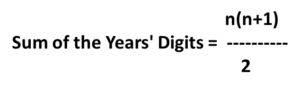
           

    The sum of the years’ digits method can also be applied on a monthly basis, in which case the above formula to calculate the sum of the years’ digits becomes much more useful.

    1. Example: Use the sum of the years’ digits method of depreciation to prepare a depreciation schedule of the following asset:
    Cost Rs.45,000
    Salvage Value Rs.5,000
    Useful Life in Years 4
    Asset is Depreciated Yearly

    Solution

    Sum of the Years’ Digits = 1 + 2 + 3 + 4 = 4 (4 + 1) ÷ 2 = 10

    Depreciable Base = Rs.45,000 − Rs.5,000 = Rs.40,000

    Year Depreciable
    Base
    Depreciation
    Factor
    Depreciation Expense Accumulated
    Depreciation
    1 Rs.40,000 4/10 4/10 × 40,000 = 16,000 Rs.16,000
    2 Rs.40,000 3/10 3/10 × 40,000 = 12,000 Rs.28,000
    3 Rs.40,000 2/10 2/10 × 40,000 = 8,000 Rs.36,000
    4 Rs.40,000 1/10 1/10 × 40,000 = 4,000 Rs.40,000

    Advantages of the sum years’ digits depreciation method

    1. The sum years’ digits depreciation method as one of the accelerated depreciation methods better matches costs to revenues because it takes more depreciation in the early years of an assets’ useful life compared to the straight-line depreciation method.
    2. This method reflects more accurately the difference in usage of different assets from one period to the other compare to the straight-line depreciation method

    Disadvantages of the sum years’ digits depreciation method

    1. SYD depreciation method might be more confusing and harder to compute compared to the straight line one.
    2. It has declining amounts of depreciation expense. Declining amounts of depreciation expense usually offset by increasing the maintenance expense which might smooth the income over the years

    REPLACEMENT OF A FIXED ASSET AND CREATION OF SINKING FUND

    The sinking fund method of depreciation is used when an organization wants to set aside a sufficient amount of cash to pay for a replacement asset when the current asset reaches the end of its useful life. As depreciation is incurred, a matching amount of cash is invested, with the interest proceeds being deposited into an asset replacement fund. The interest deposited into this fund is also invested. By the time a replacement asset is needed, the funds needed to make the acquisition have accumulated in the associated fund. This approach is most applicable in industries that have a large fixed asset base, so that they are constantly providing for future asset replacements in a highly organized manner.

  • TYPES OF CUSTOMERS IN BANK

    TYPES OF CUSTOMERS IN BANK

    Bank is an essential service sector organization. Customers play the most significant part in the bank. The customer is the one who uses the banking products and services and judges the quality of those products and services. A banking relationship is a contract between the Bank & the Customer.

    TYPES OF BANK CUSTOMERS

    During the opening of accounts, the banker deals with different types of customers. The banker should acquaint himself with various laws governing different types of customers. The customers can be classified as follows:

    1. Personal accounts: The Banker should take care and verify certain facts while opening individual accounts. As per the Indian Contract Act 1872, a person is competent to enter into a valid contract and open a bank account provided:

    i) The individual should be major, i.e. of 18 years of age;

    ii) He should be of sound mind;

    iii) He is otherwise not disqualified by any law;

    iv) He Should not be insolvent;

    v) Drunken person is not legally competent to enter into a contract;

    vi) He should be in good sense while lending a loan and entering into a contract.

    Various types of personal accounts in banks are as under:

    a)   Accounts of Single Individual: This is purely a personal account in the name of an individual and is normally operated upon by the account holder himself. The account holder may authorise another person to operate on his account. For this purpose, he gives a Mandate or executes a Power of Attorney in favour of such a person.

    In order to avoid legal complications that may arise after the death of the account holder, it is desirable to suggest the opening of a joint account in the names of two individuals (unless it is essential in certain circumstances to open an account in the single name only), and/or to obtain the proper nomination.

    b)  Joint Accounts of Individuals: A joint account is opened in the names of more than one individual for convenience of operations and/ or to avoid legal complications upon death of one of the joint account holders. A joint account is neither a partnership nor a trust account. It is important to obtain clear and unambiguous instructions regarding the mode of operation and repayment of the balance of a joint account in the event of the death of one or more joint account holder(s). Different types of operational instructions are as under:

    (i) Jointly or Survivor         (ii) Either or Survivor 

    (iii) Former or Survivor      (iv) any one or Survivor

    One or more of the joint account holders can authorise operation on the account on his/their behalf by giving a Mandate or executing a Power of Attorney, but, such Mandate or Power of Attorney must be given by all the parties to the accounts. Addition/deletion of any name, material alteration, closure of account & operational instructions in the joint account can be changed by all the account holders jointly. However, in joint accounts with operational instructions “Former or Survivor”, instructions can be changed/revoked only by Former.

    c) Illiterate person: An illiterate person is a person who cannot read or write. Such persons are competent to enter into a valid contract. The account(other than the Current Account) of such a person may be opened provided he calls the Bank with the latest passport-size photograph. A photograph is essential for identification. Thereupon, his thumb impression or mark should be obtained on the account opening form/card in the presence of the Bank’s official. Such thumb impressions or marks affixed by illiterate persons on instruments are equivalent to their signatures. Any withdrawal/repayment of the deposit amount and/or interest by way of withdrawal form or otherwise should similarly be affixed with the thumb impression or mark of the depositor.

    d) Blind Persons: Blind Persons can operate the account in a bank. Signature of Thumb impression of a blind person in the A/c opening form to be witnessed by a person who should certify that contents of the A/c opening form were explained to the blind person in his presence. The sign may be authorised by bank officer and a witness known to both the bank and the blind person. He should always visit the branch for cash withdrawal. As per all banking facilities including net banking, ATM, Cheque Book, Locker facility, loans to be offered to visually challenged customers without discrimination.

    e) Minors’ Accounts: A minor is a person below the age of 18 years. A minor is a legal incapacity to contract by himself and, therefore, a guardian recognised by law along can deal with the person and property of the minor. The term “guardian” includes a natural guardian or guardian appointed by the Court of Law.  Ordinarily, an account of a minor is opened and operated upon by the natural guardian of the minor or by the guardian appointed by the Court.

    According to RBI guidelines with a view to promote the objective of financial inclusion and also to bring uniformity among banks in opening and operating minors’ accounts, banks are advised as under:

    1. A savings /fixed / recurring bank deposit account can be opened by a minor of any age through his/her natural or legally appointed guardian.
    2. Minors above the age of 10 years may be allowed to open and operate savings bank accounts independently if they so desire. Banks may, however, keeping in view their risk management systems, fix limits in terms of age and amount up to which minors may be allowed to operate the deposit accounts independently. They can also decide, at their own discretion, as to what minimum documents are required for opening of accounts by minors.
    3. On attaining majority, the erstwhile minor should confirm the balance in his/her account and if the account is operated by the natural guardian / legal guardian, fresh operating instructions and specimen signature of the erstwhile minor should be obtained and kept on record for all operational purposes.

    Banks are free to offer additional banking facilities like internet banking, ATM/ debit card, cheque book facility etc., subject to the safeguards that minor accounts are not allowed to be overdrawn and that these always remain in credit.

    It is permissible to open any type of deposit account in the name of and/or to be operated upon by a minor within the framework of rules of business of the Bank as outlined hereunder, but no Current Account should be opened.

    According to Section 26 of the NI Act, a minor can draw, endorse or negotiate a cheque or a bill but he cannot be held liable on such cheques or bill. Minor can be admitted to the benefits of partnership with the consent of other partners but cannot be made liable for the losses. A minor may be appointed as an agent on behalf of his principal but legally he cannot be held responsible to his principal.

    When the minor becomes major he has the sole right to operate the account and the guardian’s power ceases. The payment should be made to the erstwhile minor upon providing his identity. When the account is operated upon by the guardian on behalf of the minor a Balance Confirmation Letter duly signed by the erstwhile minor and verified by the guardian. If an account is operated by the minor himself, the erstwhile minor should be asked to sign a Balance Confirmation Letter.

    2. Hindu Undivided Family(HUF): Hindu Undivided Family’ otherwise known as ‘Joint Hindu Family’ property, business or ancestral estates and its common possession, enjoyment ownership is the basis of the formation of HUF.As per Hindu law, the Hindus, Buddhists, Sikhs & Jains can form HUF.

    HUF is governed basically by two schools of thought. In Bengal and Assam, it is governed by Dayabhag Law. In other parts of India, it is governed by Mitakshara Law. The law governing the Hindu Undivided Family is codified under the Hindu Code and now, succession among Hindus is governed by the Hindu Succession Act, 1956. Parts of this Act were amended in 2005 by the Hindu Succession (Amendment) Act, 2005.Creation of Hindu Law under which all major members of the family get right by birth in the ancestral property of the family.

    HUF property is managed by a senior member called ‘Manager’ or ‘Karta’. Upon the death of Karta, the next senior coparcener becomes Karta. Joint owners of HUF are known as coparceners. It consists of one common living ancestor and his all male & female (female included from Sept. 2005) descendent up to three generations next to him. HUF cannot enter into a partnership as per the Supreme Court judgment of 1998.

    The HUF account is operated by Karta. Karta has the authority to borrow money for family necessities & for ancestral family business. Documents are to be executed by Karta. All major coparceners are to be made guarantors. The liability of the ‘Karta’ is unlimited, whereas the liability of the coparceners is limited to their shares in the joint family estate.

    3. Sole Proprietary Firms: A business is wholly owned by an individual. In law, there is no difference between the proprietor & the firm. In all respects, it is an account in the name of an individual only except that it is operated upon by the proprietor on behalf of the firm. The firm should have PAN or GST Number. A proprietorship letter in the bank’s Performa is to be obtained. Proof of proprietorship to be obtained. Creditors have recourse not only against assets of the firm but also against the private assets of the proprietor. The proprietor can authorize another person to operate the account through Mandate or Power of Attorney.

    For opening an account in the name of a sole proprietary firm, the CDD of the individual (proprietor) shall be carried out. In addition to the above, any two of the following documents as proof of business/ activity in the name of the proprietary firm shall also be obtained:

    (a) Registration certificate 

    (b) Certificate/license issued by the municipal authorities under the Shop and Establishment Act.

    (c) Sales and income tax returns.

    (d) CST/VAT/ GST certificate (provisional/final).

    (e) Certificate/registration document issued by Sales Tax/Service Tax/Professional Tax authorities.

    (f) IEC (Importer Exporter Code) issued to the proprietary concern by the office of DGFT or Licence/certificate of practice issued in the name of the proprietary concern by any professional body incorporated under a statute.

    (g) Complete Income Tax Return (not just the acknowledgment) in the name of the sole proprietor where the firm’s income is reflected, duly acknowledged by the Income Tax authorities.

    (h) Utility bills such as electricity, water, landline telephone bills, etc.

    In cases where the Regulated Entities (REs) are satisfied that it is not possible to furnish two such documents, Regulated Entities (REs) may, at their discretion, accept only one of those documents as proof of business/activity.

    Provided Regulated Entities (REs) undertake contact point verification and collect such other information and clarification as would be required to establish the existence of such firm, and shall confirm and satisfy itself that the business activity has been verified from the address of the proprietary concern.

    4. Partnership Firm: Partnership is the relation between persons who have agreed to share profits of business carried on by all or any one of them acting for all (Indian Partnership Act 1932). As per RBI instruction now Registration Certificate and Partnership deed to be obtained.  The Indian Partnership Act does not mention anything about the maximum number of partners in a partnership firm. The Central Government has prescribed a maximum number of partners in a firm to be 50 vide Rule 10 of the Companies (Miscellaneous) Rules, 2014. Thus, in effect, a partnership firm cannot have more than 50 members”. A partnership is not a distinct legal person from the partners who have made a partnership firm. HUF cannot enter into a partnership as per the Supreme Court judgment of 1998. The firm should have PAN or GST Number. A partner cannot delegate his authority to operate the account.

    In case of death/retirement/insolvency of a partner account should be stopped, if the balance is in debit and a fresh account should opened after fresh sanction of limit. In case of dispute when one partner revokes the authority against the other partner, operation in the account should be stopped.

    Dissolution of the Partnership firm can take place by the following ways:

    1. By mutual consent;
    2. Death/insolvency/retirement of a partner;
    3. Operation of Law (insolvency of all partners, business becoming unlawful, dissolution    by a competent court; and
    4. In case of automatic dissolution.

    5. Limited Liability Partnership (LLP): A limited liability partnership (LLP) is a partnership in which some or all partners (depending on the jurisdiction) have limited liabilities. LLP is governed by the Limited Liability Partnership Act 2008. Liability is limited to the extent of his contribution in the LLP. Minimum 2 designated partners and no limit on the maximum number of Partners. A partner is not liable for another partner’s misconduct or negligence, except in certain cases. LLP is a legal entity separate from its partner. It has own assets in his name, sure and be sued. Since LLP contains element of both ‘a corporate structure’ as well as ‘a partnership firm structure’ LLP is called a hybrid between a company and a partnership. It has perpetual succession (the death of a partner does not affect the existence of LLP). Partners have a right to manage the business directly. Firms and companies can get themselves converted into LLP. LLP cannot raise funds from the public.

    6. Companies: Companies are defined in the Indian Company Act 1956. As per the provision of Company Act 2013 (implemented with effect from 1st April 2014), recognizes a joint Stock Company is a legal person with perpetual entity & is distinct from its members. A company or association of persons can be created at law as a legal person so that the company in itself can accept limited liability for civil responsibility. Because companies are legal persons, they also may associate and register themselves as companies otherwise it will be treated as illegal. Address of the registered office is compulsory. It is the address at which all the documents & notices may be served upon the company. Cheques favouring company are not to be credited to the personal accounts of the Directors or other officers of the company.

    The following documents are required for the account opening of a company:

    i) Certificate of Incorporation: Issued by Registrar of Companies. It is conclusive proof for incorporation of the company & compliance of all formalities by promoters.

    ii) Certificate of commencement of business: A company having share capital cannot commence business until it has obtained the certificate to commence business (COB) from the concerned Registrar of Companies. Certificate of commencement of business is not required by Private Ltd. Co. as its shares are closely held & it can commence business on its incorporation.

    iii) Memorandum of Association: Company’s fundamental & unalterable law. Embodies Company’s name, Authorized capital, Objectives of the company, Liability of shareholders.

    iv) Article of Association: Regulations controlling internal management of the company. Rights & powers of the Directors, rules about conduct of company meetings & business, Procedure for borrowing & limit on borrowing etc.

    iv) Copy of Board Resolution: Certified copy of Board Resolution authorizing to borrow from the Bank with details of limit, security etc., Persons who are authorized to sign the security documents & operate the Bank Account, persons in whose presence Seal of the company will be affixed to the security documents.

    v) Company identification Number (CIN): As per RBI guidelines Company Identification Number (CIN) assigned by the ROC is now compulsory for opening of bank account of the company.

    vi) Company common Seal: The common seal if any, of the company available, should be embossed on the bank`s documents. As per Companies (Amendment) Act, 2015 and RBI instructions Company Common Seal is not necessary if other documents are available during the current account opening.

    Different types of companies in India

    a) Private Company: Private Company has shareholders with limited liability and its shares may not be offered to the general public. Private Limited Company has a no minimum paid-up share capital limitation now. (As per the Companies (Amendment) Act, 2015, paid-up share capital of one lakh rupee or such higher paid-up share capital as may be prescribed is omitted now).  It has a minimum of two members and a maximum member restricted to two hundred and a Minimum two directors and no maximum number of directors is restricted.

    b) Public Company: Public company means a company that is not a private company and has no minimum paid-up share capital limitation now (As per Companies (Amendment) Act, 2015, paid-up share capital of five lakh rupee or such higher paid-up share capital as may be prescribed is omitted now). Shares are offered to the public & are listed on the stock exchange. Minimum seven members no limit of maximum number. Minimum 3 directors maximum 15 director limits. Provided that a company may appoint more than fifteen directors after passing a special resolution (As per Companies Act 2013, no Central Govt. permission is required now). At least one-woman director shall be on Board. A certificate of commencement of business is a must to do any type of business.

    c) Government Company: “Government Company” means any company in which not less than fifty one percent. Of paid-up share capital is held by the Central Government, or by any State Government, or partly by the Central Government and partly by one or more State Governments and includes a company which is a subsidiary company of such a Government company.

    d) One Person Company: The Companies Act 2013 Act introduces a new type of entity to the existing list i.e. apart from forming a public or private limited company, the 2013 act enables the formation of a new entity a ‘one-person company’ (OPC). An OPC means a company with only one person having a sole member [section 3(1) of 2013 Act]. An OPC can be formed only by an Indian Resident and citizen.

    e) Other Companies: As per the Companies Act 1956, companies can be classified on the basis of time, place of incorporation and nature of working share capital as follows:

    i) Foreign Company: It means a company incorporated outside India and having a place of business in India whether by itself or through an agent, physically or through electronic mode and conducting any business activity in India in any other manner.

    ii) Existing Company: A company which is established before the Company Act 1956 is called Existing Company.

    iii) Holding Company: A company is known as the holding company of another company if it has control over another company.

    iv) Subsidiary Company: A company is known as a subsidiary of another company when control is exercised by the latter over the former called a subsidiary company. A company is to be deemed to be a subsidiary company of another.

    7. Trust: Trusts are governed by the Indian Trust Act, 1882. A trust is created when ownership of a property is transferred to someone for holding or managing it for the benefit of another person(s). A trust may be a public charitable trust or a private trust (for the benefit of private individuals). Trusts are managed by trustees. Loan can be granted if it is for the purpose of the trust. The trustee is authorised to borrow as per the trust deed. Original Trust Deed to be examined before financing. Certificate of Registration under Public Trust Act to be examined & copy to be kept on record.

    8. Clubs & Societies: Clubs & Societies are non-profit making organisation and represent a group of persons. These are normally incorporated under Cooperative Society Act. Clubs can be registered under Society Act 1860, or Company Act 1956. These get the status of a legal entity only after their incorporation in their own name. These are governed by rules & regulations (bye laws). A certified true copy of the resolution. Cheques favouring society, club, association not to be collected in individual accounts of office bearers or employees.

  • STARTUP INDIA SCHEME – AN EFFECTIVE INSTRUMENT FOR INDIA’S TRANSFORMATION

    STARTUP INDIA SCHEME – AN EFFECTIVE INSTRUMENT FOR INDIA’S TRANSFORMATION

    Startup India:

    Startup India is a flagship initiative of the Government of India, intended to build a strong ecosystem for nurturing innovation and Startups in the country that will drive sustainable economic growth and generate large-scale employment opportunities. A start-up technically is any enterprise that is working on the growth, commercialization, and creation of brand-new products, services, or mechanisms that are driven by intellectual property or new tech. 

    The Startup India Action Plan was unveiled by Prime Minister Mr. Narendra Modi on 16th January 2016 to highlight several initiatives and schemes proposed by the Government of India to build a strong eco-system to nurture innovation and empower Startups across India.

    Presently it is not at all surprising to see that India is growing up as a hub of the biggest startups. One 97 Communications (PayTM), Ola cabs, Dream 11, Swiggy, and Razorpay are a few of the richly valued Indian startups across the world. The country is now getting more startup unicorns, including companies from the sectors like Healthtech, social commerce, finance, and more. Unicorn companies in the business are those startups that value more than $ 1 billion.

    The 19-point Action Plan envisages several incubation centers, easier patent filing, tax exemptions, ease of setting up of business, an INR 10,000 crore corpus fund, and a faster exit mechanism, among others.

    The Government of India has initiated, the National Startup Awards, to acknowledge and appreciate fledgling entrepreneurs who are bringing about significant changes in their sectors. The awards seek to identify and honour innovative entrepreneurs who are making a mark in the early stages of their ventures.

    In addition to awards, other government support can also play a crucial role in the success of early-stage startups. This support comes in various forms, such as funding, grants, incentives, and mentorship programs to help the startups navigate the challenges of building and growing a business.

    What are Start-Ups?

    According to the Ministry of Commerce and Industry Department of Promotion of Industry and Internal Trade, a Start-Up may be defined as:

    • If it is incorporated as either a Private Limited Company, Registered Partnership Firm, or Limited Liability Partnership. A sole proprietorship or a public limited company is not eligible as a startup.
    • If it is up to 10 years from the date of its incorporation/ registration.
    • If its turnover for any of the financial years has not exceeded INR 100 crore.
    • If it is working towards innovation, development, or improvement of products or processes, or services, or if it is a scalable business model with a high potential of employment generation or wealth creation.
    • Should not have been formed by splitting up or reconstruction of a business already in existence.

    Growth of Startups in India

    “The government has taken several measures for start-ups and they have borne results. India is now the third-largest ecosystem for start-ups globally and ranks second in innovation and quality among middle-income countries,” Ms. Sitharaman said as she presented the Union Budget 2023-24 in the Lok Sabha.

    Startup India is a Government of India flagship initiative to build Startups and nurture innovation. Through this initiative, the Government plans to empower Startup ventures to boost entrepreneurship, economic growth, and employment across India.

    Other Support Provided by the Government

    1. Funding from angel investors and venture capital firms becomes available to startups only after the proof of concept has been provided. Similarly, banks provide loans only to asset-backed applicants. It is essential to provide seed funding to startups with innovative ideas to conduct proof of concept trials.
    2. Incubators play a vital role in the growth of startups. They provide the necessary resources such as infrastructure, mentorship, and financial support to nurture and support the innovation of startups. India has 400+ Incubators with most of them at the nascent stage. Startup India aims to enhance the capacities of the existing incubators and also provide support in setting up new incubators.
    • Up to Rs. 20 Lakhs as a grant for validation of Proof of Concept, prototype development, or product trials. The grant shall be disbursed in milestone-based installments. These milestones can be related to the development of prototypes, product testing, building a product ready for market launch, etc.
    1. Ministry of Corporate Affairs has notified Startups as ‘fast track firms’ enabling them to wind up operations within 90 days vis-a-vis 180 days for other companies. Startups with simple debt structures or those meeting such criteria as may be specified may be wound up within a period of 90 days from making an application for winding up on a fast-track basis.
    2. The recognised startups that are granted an Inter-Ministerial Board Certificate are exempted from Income Tax for a period of 3 consecutive years out of 10 years since incorporation
    3. Startups incorporated on or after 1st April 2016 but before 1st April 2023 can apply for income tax exemption under Section 80IAC of the Income Tax Act
    • The FM proposed the extension of the date of incorporation for income tax benefits to startups from 31.03.2023 to 31.03.2024
    • A guaranteed coverage of up to Rs.10cr is available to Startups.

    Bank Finance for Start-up Scheme

    Funding support by the banks is available to eligible Start Ups recognized by the Department of Promotion of Industry and Internal Trade (DPIIT). Eligibility criteria for bank finance are as under:

    • Start-Ups are defined, as per the policy of the Bank.
    • The unit must be eligible and certified as a start-up by the concerned government authority as per Start Up India Scheme.
    • The constitution of the unit should be a private limited company (under the companies act 2013), Registered Partnership firm (under the Indian Partnership Act 1932), and limited liability Partnership (Under the partnership act 2008).
    • The startup must have stable revenue as assessed from audited monthly statements over 12 months.
    • The startup must not be in default to any lending institution/Bank.

    Term Loan/Working Capital/Non-fund-based limit Composite loan may be considered at the time of initial sanction. Assessment is to be made as per the credit policy of the Bank. The facility up to Rs.10 Cr may be covered under Credit Guarantee Scheme for Startup (CGSS).

    Credit Guarantee Scheme for Startups (CGSS)

    The Department for Promotion of Industry and Internal Trade (DPIIT), Ministry of Commerce and Industry has notified the establishment of the Credit Guarantee Scheme for Startups (CGSS) for providing credit guarantees to loans extended by Scheduled Commercial Banks, NonBanking Financial Companies and Securities and Exchange Board of India (SEBI) registered Alternative Investment Funds (AIFs). Getting a startup off the ground is not an easy task for any entrepreneur. Lack of adequate funding when required, and the high-risk perception of the banks towards this segment, have most often been the two major reasons why startups have found it so difficult to even set up shop.

    The Government of India, to give a much-needed boost to the startup industry, has recently announced a special scheme, known as the Credit Guarantee Scheme for Startups or Credit Guarantee Fund Scheme or CGSS. An offshoot of the Startup India plan launched by the Prime Minister, this scheme, with a contribution of Rs.2000 crore, will enable startups to obtain collateral-free loans for starting businesses.

    CGSS is aimed at providing credit guarantees up to a specified limit against loans extended by Member Institutions (MIs) to finance eligible borrowers viz. startups as defined in the gazette notification issued by DPIIT and amended from time to time. The credit guarantee cover under the scheme would be transaction-based and umbrella based. The exposure to individual cases would be capped at INR 10 crore per case or the actual outstanding credit amount, whichever is less. In respect of transaction-based guarantee cover, the guarantee cover is obtained by the MIs on a single eligible borrower basis. Transaction-based guarantees will promote lending by Banks/ NBFCs to eligible startups. The extent of transaction-based cover will be 80% of the amount in default if the original loan sanction amount is up to INR 3 crore, 75% of the amount in default if the original loan sanction amount is above INR 3 crore, and up to INR 5 crore, and 65% of the amount in default if the original loan sanction amount is above INR 5 crore (up to INR 10 crore per borrower).

    Challenges and Opportunities in Start-ups

    There are around 99,380 startups that have been registered in India as of July 2023. Entrepreneurship and startups are only a recent phenomenon in the country. It is only in the last decade and a half that people in the country have moved from being job seekers to job creators. Doing a startup is tough and every country sees more failures than success. 

    Challenges

    The Challenges before Start-ups are:

    1. Financial resources: Availability of finance is critical for startups and is always a problem to get sufficient amounts. Several finance options ranging from family members, friends, loans, grants, angel funding, venture capitalists, crowdfunding etc are available. The requirement starts increasing as the business progresses. Scaling of business requires a timely infusion of capital.
    2. Revenue generation: Several startups fail due to poor revenue generation as the business grows. As the operations increase, expenses grow with reduced revenues forcing startups to concentrate on the funding aspect, thus, diluting the focus on the fundamentals of business. Hence, revenue generation is critical.
    3. Team members: Startups normally start with a team consisting of trusted members with complementary skill sets. Usually, each member is specialized in a specific area of operations. Assembling a good team is the first major requirement, failure to have one sometimes could break the startup
    4. Supporting infrastructure: Several support mechanisms play a significant role in the lifecycle of startups which include incubators, science and technology parks, business development centers, etc. Lack of access to such support mechanisms increases the risk of failure.
    5. Creating awareness in markets: Startups fail due to a lack of attention to limitations in the markets. The environment for a startup is usually more difficult than for an established firm due to the uniqueness of the product. The situation is more difficult for a new product as the startup must build everything from scratch.
    6. Lack of mentorship: Lack of proper guidance and mentorship is one of the biggest problems that exist in the Indian startup ecosystem. Most startups have brilliant ideas and/or products but have little or no industry, business, and market experience to get the products to the market.

    Opportunities

    1. India’s large population: The population of India is a huge asset for the country. It is expected that the working-age population would surpass the non-working population. This unique demographic advantage will offer a great opportunity for any startup.
    2. Huge Investments in Startups: Huge investment in Indian startups from foreign and Indian investors is taking place.
    3. Connectivity: Indian telecom industry has nearly 100 crore subscribers, and mobile connectivity has made inroads in the rural and urban population. The government of India’s digital push is going to improve connectivity and data to the next level. The race to the cheapest data has started and disruption is certain. The cheap data has helped everyone to get their hands on it, start-ups will have an easier time tapping into markets, territories, and even traditional businesses.
    4. Change of Mind Set of the Working Class: Traditional career paths will be giving way to the Indian startup space. Challenging assignments and good compensation packages would attract talented people to startups. Also, it is seen that several high-profile executives are quitting their jobs to start or work for startups
    5. Innovation Society: India has the largest youth population, which is the largest driver for innovation, workforce, talent, and future leaders. India has its challenges in education, health, infrastructure, and the rising gap between India and Bharat. This presents a big opportunity for start-ups to solve a variety of problems. The large diversity in India’s population makes a strong case for a rich services and products economy. Start-ups should look at banks; our banking system has reaped the maximum benefit of our population size.

    The details of funds allocated under Fund for Funds for Start-ups where The Government has established FFS with a corpus of Rs. 10,000 crores, to meet the funding needs of startups are as follows:

    The details of the amount allocated and utilized under the Fund of Funds for Startups, State/UT-wise as of 30th November 2022 are as under:
    Name of State/ UT Total Amount Allocated in Rs. Crore (Committed to the Alternative Investment Funds) Total Amount Utilised in Rs. Crore (Drawdowns made by the Alternative Investment Funds and Disbursed by SIDBI)
    Assam                                           25.00                                               16.48
    Delhi                                         751.00                                              539.31
    Gujarat                                         100.00                                                51.75
    Haryana                                         111.00                                                34.42
    Karnataka                                     1,719.75                                              754.15
    Maharashtra                                     4,241.20                                          1,450.58
    Tamil Nadu                                         450.00                                              279.05
    Telangana                                         130.00                                                78.56
    Grand Total                                     7,527.95                                          3,204.29

    Our Bank has been a pioneer in financing Startups and recently unveiled its ambitious plan to set up three dedicated centers for startups in key cities, namely Mumbai, Bengaluru, and Delhi. The initiative aligns with the government’s vision of promoting innovation and entrepreneurship and falls under the Department for Promotion of Industry and Internal Trade’s (DPIIT) umbrella.

    The current economic scenario in India is in expansion mode. The Indian government is increasingly showing greater enthusiasm to increase the GDP rate of growth from grass root levels with the introduction of liberal policies and initiatives for entrepreneurs like ‘Make in India’, ‘Startup India’, MUDRA, etc. ‘Make in India’ is a great opportunity for Indian start-ups. With the government going full hog on developing entrepreneurs, it could arrest the brain drain and provide an environment to improve the availability of local talent for hiring by startup firms. The startup arena has a lot of challenges ranging from finance to human resources and from launch to sustaining growth with tenacity. Being a country with a large population, the plethora of opportunities available are many for startups offering products and services ranging from food, retail, and hygiene to solar and IT applications for day-to-day problems which could be delivered at affordable prices.

  • CREDIT GUARANTEE FUND TRUST FOR MICRO & SMALL ENTERPRISES (CGTMSE) 2023

    CREDIT GUARANTEE FUND TRUST FOR MICRO & SMALL ENTERPRISES (CGTMSE) 2023

    MSME is the pillar of economic growth in many developed and developing countries in the world. Though India is still facing infrastructural problems, lack of proper market linkages, and challenges in terms of the flow of institutional credit, it has seen tremendous growth in this sector.  

    THE CREDIT GUARANTEE SCHEME (CGS)

    Businesses, especially MSMEs, require a steady source of finance if they are to meet the hiccups of kick-starting their business and growing it. Though business loans are available, they are difficult to obtain when the MSME is in its nascent stage. The Credit Guarantee Scheme offers unsecured loan facilities to MSME businesses. MSME businesses can avail of term loans or working capital loans under the scheme.

    The Credit Guarantee Scheme (CGS) seeks to reassure the lender that, in the event of an MSE unit, which availed collateral- free credit facilities, fails to discharge its liabilities to the lender, the Guarantee Trust would make good the loss incurred by the lender up to 85 per cent of the outstanding amount in default.

    CREDIT GUARANTEE FUND TRUST FOR MICRO & SMALL ENTERPRISES (CGTMSE)

    Ministry of Micro, Small & Medium Enterprises (MSME), Government of India (GOI) and Small Industries Development Bank of India (SIDBI) set up Credit Guarantee Fund Trust for Small Industries (CGTSI) in August 2000. The GOI and SIDBI as settlors of the Trust have committed a corpus of Rs.2,500 crore in the ratio of 4:1 to the CGTMSE, out of which Rs. 1,906 crore has been contributed to date. Credit Guarantee Fund Trust for Micro & Small Enterprises (CGTMSE) w.e.f.  2nd July 2007.

    UPDATION IN CGTMSE POLICY

    CGTMSE updated his policy regularly. Major changes were announced by CGTMSE in February 2018. In January 2023 CGTMSE has recently brought out many modifications in the existing guarantee scheme and added Benefits to Agniveers under CGTMSE. Three major modifications have been considered by the CGTMSE as per the circular dated 31st March 2023.

    MAJOR POLICY CHANGES IN CGTMSE IN FEBRUARY 2018

    Following policy changes in Credit Guarantee Scheme were announced in an event “Rebooting CGTMSE” organized by the Ministry of MSME and CGTMSE on February 20, 2018:- 

    1. Charging Annual Guarantee Fees (AGF) on Outstanding Loan Amount rather than sanction amount.
    2. Expanding the Coverage of the Credit Guarantee Scheme (CGS) to cover the MSE Retail Traders segment.
    3. Allowing loans with Partial Collateral Security under Credit Guarantee Scheme.  
    4. Increase in the extent of guarantee coverage to 75% from the existing 50% for proposals above ₹50 lakh.
    5. Enhancing the IT infrastructure of the Trust to improve operational efficiencies and reduce the turnaround time for claim settlement.  

    The above-mentioned steps undertaken by the Trust are expected to greatly increase the attractiveness of the scheme and increase the operational efficiency of the Trust.  This in turn is expected to increase the credit guarantees availed by MLIs and help in enhanced flow of credit to the MSE sector and betterment of the sector as a whole.

    POLICY CHANGES IN CGTMSE IN JANUARY 2023

    CGTMSE has brought out the following modifications in January 2023 in his existing guarantee scheme as below.

    1. Extending special benefits to units of UT of Jammu & Kashmir, UT of Ladakh, and units promoted by Persons with disability (PwD), Agniveers.
    2. Increase in the threshold for waiver of Legal Action.
    3. Modification in the alignment of guarantee for Retail/Wholesale trade with other segments.
    4. Introduction of Manipur Credit Guarantee Scheme (MCGS).

    POLICY CHANGES IN CGTMSE IN MARCH 2023

    CGTMSE has recently brought out the following modifications in the existing guarantee scheme as per circulars dated 31st March 2023 as under.

    1. Increase in the ceiling of coverage from Rs.2 Cr to Rs.5 Cr.
    2. Reduction in Annual Guarantee Fee.
    3. Increase in the threshold for Waiver of Legal Action to Rs.10 Lakhs & option for claim settlement in a single instalment.

    ELIGIBLE LENDING INSTITUTIONS UNDER THE SCHEME

    All Scheduled Commercial Banks (either PSU, Private or Foreign Banks), selected Regional Rural Banks, selected state financial corporations or NBFC or such of those institutions as may be directed by GOI can avail of guarantee cover in respect of their eligible credit facilities under the Scheme. Small Industries Development Bank of India (SIDBI), National Small Industries Corporation Ltd. (NSIC) and North Eastern Development Finance Corporation Ltd. (NEDFC) have been included as eligible institutions.

    ELIGIBILITY OF BORROWERS FOR CGTMSE COVERAGE

    1. All Credit Facilities sanctioned to Micro & Small units defined as per the MSMED act 2006, based on investment in  Plant & Machineries/Equipment.
    2. Units under both sectors viz. Manufacturing and Services including Retail Trade, can be covered under CGTMSE.
    3. All the units should be engaged in the activity as approved by CGTMSE for coverage.
    4. All units should have a valid Udyog Adhaar No. (UAN).
    5. The maximum Quantum of loan to a single borrower eligible for coverage should not exceed Rs. 500 Lakhs.
    6. For loans up to Rs  10 Lakhs,  no  collateral security  or third  party guarantee should  be obtained, to be eligible  under the scheme.
    7. For loans above Rs 10 Lakhs, Partial Collateral security may be obtained. The details of the same has been explained in para 10, under the Hybrid model of the scheme.
    8. Under the Credit Guarantee Scheme, the CGTMSE encourages composite credit being extended to a single borrower by a Bank.  Joint financing by a financial institution (e.g.  Small Industries Development Bank of India, National Small   Industries   Corporation, and   North   Eastern   Development   Finance Corporation Ltd.etc) and commercial bank can be covered under the scheme. For   g.    MSE    unit   is   financed  by   term  loan from   State   financial institution/development   financial   institution   and   Working    capital   from   a commercial bank.  However, sharing of securities will not be permitted.
    9. Loan under Consortium are not eligible under the scheme.
    10. Loans to SHGs are not eligible under the scheme.
    11. Wholesale Trade & Educational Institution are now covered to be covered under the scheme.

    CREDIT FACILITIES & PARAMETERS

    Fund and non-fund based (Letters of Credit, Bank Guarantee etc.) credit facilities up to Rs. 500 lahks per eligible borrower are covered under the guarantee scheme provided they are extended purely on the project viability without collateral security or third-party guarantee. A lender can extend either a term loan or working capital facility alone and still be eligible for a guarantee cover if it meets the other eligibility parameters.

    CGTMSE COVER FOR BORROWERS ENGAGED IN RETAIL TRADE

    Credit Facility extended to borrowers engaged in Retail Trade activity will now be covered under the CGTMSE scheme with effect from 28.02.2018 (credit facility eligible for coverage on or after 28.02.2018). In the initial stage of eligibility, AGF of the Retail Trade was different from other activities. Now all the features of Retail Trade are at par with other activities.

    COLLATERAL SECURITY ACCEPTED UNDER THE SCHEME

    No collateral security for loans up to Rs.10   Lakhs. Collateral Security would mean any asset other than a business asset. Waiver of collateral  security may  be extended  for loans  over  Rs.10  Lakhs and up to Rs. 25  Lakhs subject  to the good track  record  and financial  position of the borrower.

    In view of several requests from various MLIs regarding coverage of Partial Collateral Security, it has been decided to make it effective from the date of issue of Circular. Therefore, the modification of allowing partial collateral security under the ambit of Credit Guarantee Scheme of CGTMSE is applicable to fresh credit facilities eligible for guarantee coverage by MLIs on or after February 28, 2018.

    MODIFIED AGF STRUCTURE- STANDARD RATE (SR)

    In pursuit of revamping of Credit Guarantee Scheme to increase the flow of credit to MSEs, it has been decided to bring down the cost of the guarantee. Further, guarantee fees for Retail / Wholesale Trade is made at par with other activities. The revised Annual Guarantee Fee (AGF) structure under Credit Guarantee Scheme (CGS -I) applicable to all the guarantees approved/ renewed on or after April 01, 2023, is given in the table below.

    Slab Standard Rate

    (%pa)

    Standard Rate with

    Risk Premium (%pa)

    0-10 lakh 0.37 0.63
    Above 10-50 lakh 0.55 0.94
    Above 50-1 crore 0.60 1.02
    Above 1-2 crore 1.20 2.04
    Above 2-5 crore 1.35 2.30

    GUARANTEE COVER

    Guarantee cover for the entire agreed tenure of the Term Credit/ Composite Credit for the defaulted principal amount. Other Charges such as interest in term loans, Penal Interest, Commitment Charges, Service charges, or any other expenses shall not qualify for guarantee cover. Lock in period is 18 months from the date of the last disbursement of the loan or the date of payment of the guarantee fee whichever is later.

    EXTENT OF GUARANTEE COVER AVAILABLE W.E.F. 01/04/2023
    Category Up to ₹ 5.00 lakh More than ₹ 5.00 lakh to  ₹ 50.00 lakh More than ₹ 50.00 lakh to ₹ 500.00 lakh
    Micro Enterprises 85% of the amount default amount Max. ₹ 4.25 Lakh 75% of the amount default amount Max. ₹ 37.50 Lakh 75% of the amount default amount Max. ₹ 375.00 Lakh
    MSE Located in UT of J&K/ UT of Ladakh/ NE Region      80% of the amount default amount Max. ₹ 40. Lakh 75% of the amount default amount Max. ₹ 375.00 Lakh
    Women/SC/ST/PwD/MSE promoted by Agniveers/ MSE situated in Aspirational District/ ZED Certified MSEs 85% of the amount default amount Max.  ₹ 425.00 Lakh
    All others 75% of the amount default amount Max.  ₹ 375.00 Lakh


     PERIOD FOR THE GUARANTEE COVERAGE

    The guarantee cover will commence from the guarantee start date and shall run through the agreed tenure of the term credit in respect of term credit / composite credit. Where working capital alone is extended to the eligible borrower, the guarantee cover shall be for a period of 5 years or a block of 5 years or for such period as may be specified by the trust on this behalf.

     APPLICATION FOR GUARANTEE COVER PAYMENT OF AGE

    Application for Guarantee cover lodged online through Administrative Office designated as Nodal Offices.

    (i) Annual Guarantee fee (first-time fee) shall be paid to the Trust by the institution availing of the guarantee within 30 days from the date of first disbursement of credit facility or 30 days from the date of Demand Advice (CGDAN) of guarantee fee whichever is later or such date as specified by the Trust.

    (ii) The Annual Guarantee fee (after first time fee) at a specified rate (as specified above) on a pro-rata basis for the 2nd and last year and in full for the intervening years would be generated by the 2nd week of February every year. AGF so demanded would be paid by the MLIs on or before 30th March each year or any other specified date by CGTMSE, of every year.

     INVOCATION OF GUARANTEE

    MCGS’s total guarantee coverage is a maximum upto 10% NPA level of the crystalized portfolio of MLI. The claims for the entire year will be processed for payment by MCGS after the crystallization of the annual portfolio of the MLI with MCGS.

     NPA MARKING

    The Member Lending Institutions (MLIs) are required to inform the date on which the account was classified as NPA in a particular calendar quarter by the end of the subsequent quarter using the following option in the online system.

     CLAIM SETTLEMENTS ON DEFAULT OF A LOAN ARE AS UNDER

    The lending institution may invoke the guarantee in respect of the credit facility within a maximum period of 3 years from the NPA date or lock-in period whichever is later

    • The lender shall prefer a claim on the defaulted account on recall of the loan and initiation of recovery proceedings under due process of Law. The lender can, however, invoke the guarantee given by the Trust only after the lock-in period of 18 months either from the date of the last disbursement of credit to the borrower or from the date of the guarantee cover coming into force in respect of the particular credit facility, whichever is later.
    • After satisfying itself about the procedural aspects met by the lender, regarding lodgement/preferment of a claim for the guarantee, the Trust will honour 75% of the guaranteed portion of the amount in default, subject to a maximum of 75%/80%/85% of the amount in default. The balance of 25% shall be paid at the conclusion of the recovery proceedings.
    • For the scheme, the issue of notice under Lok Adalat is sufficient to prove the legal proceedings have been initiated.
    • Mere issuance of recall notice under the SARFAESI Act cannot be construed as an initiation of legal proceedings for the preferment of a claim under CGS. Lending institutions should take further action as contained in Section 13 (4) of the above Act.

    WAIVER OF LEGAL ACTION IN NPA ACCOUNTS

    • For the scheme, the issue of notice under Lok Adalat is sufficient to prove that legal proceedings have been initiated for the cases where the total default is up to ₹ 20 lakhs only.
    • Waiver of Legal action in respect of smaller loans: CGTMSE has waived the pre-condition of initiation of legal proceedings for invoking guarantees where the aggregate outstanding amt. considered eligible for claim settlement by CGTMSE does not exceed ₹ 5 lacks for those claims lodged on or after 02.01.2023.
    • Now, CGTMSE has revised the threshold for waiver of legal action to ₹ 10 lacks per claim for claims lodged on or after 01.04.2023.
    • In all such cases, where the filing of legal proceedings is waived, a committee headed by an officer, not below the rank of Assistant General Manager of MLI should examine all such accounts and decide not to initiate legal action and file a claim under the Scheme. The report of such a committee may be submitted along with the claim application.

    SETTLEMENT OF CLAIM

    • Settlement of claim is to be entered and verified by this menu. The CGTMSE shall pay 75% of the guaranteed amount within 30 days.
    • The balance 25% will be paid at the conclusion of the recovery proceeding or after 3 years from the decree of recovery, whichever is earlier. Any amount realized from the sale of security should be remitted in full to the corporation after deducting our expenses etc.

    CGTMSE CLAIM SETTLEMENT OFFER IN NPA ACCOUNTS

    Further, CGTMSE has decided to offer MLIs two options for claim settlement at the time of claim lodgement for cases where a waiver of legal action is applicable.

    • Option-1: Single instalment of claim settlement with reduced extent of guarantee by 15%. Eg: in respect of the extent of coverage of 75%, reduced coverage would be 60%, and 80% would be 65% likewise.
    • Option-2: Existing claim settlement process in two instalments i.e. 75% 1st instalment and 25% after 3 years as 2nd

    CGTMSE has its Registered Office in Mumbai and does not have any branches. Since the entire operations are online, CGTMSE can cater to the needs of its MLIs from Mumbai.